

Two months after what the Iranian government has described as the “restoration of international internet access”, new data from the Iranian Students Polling Agency (ISPA) paints a very different picture of the everyday internet experience in Iran. Rather than a genuine return to normal connectivity, the findings point to a gradual and less visible erosion of Iranians’ connection to the global internet.
Iranian users now spend an average of just 4 hours and 3 minutes online each day—around 39% below the global average. But the more revealing comparison is not with the rest of the world. It is with ISPA’s previous survey, conducted in June 2025, before the Twelve-Day War.
Over the course of a year, the share of people who spend relatively little time online has grown, while the share of heavy internet users has fallen sharply. The shift is even reflected in how the latest survey categorizes daily internet use: the previous “5 to 10 hours” category has disappeared, leaving only a broader “5 hours or more” option.
At the same time, July 2026 brought a new wave of restrictive internet policies, expanded surveillance of online activity, infrastructure disruptions, and new forms of filtering. Altogether, these developments suggest that although Iranian users remain technically connected to the network, they have less access than before to a genuinely usable, affordable, and reliable global internet.
Key Findings
1. Iranians are spending less time online than they did a year ago.
A comparison of ISPA surveys conducted in June 2025 and June 2026 shows a significant decline in the share of users in what had been the largest internet-use category. The share of users spending 2-5 hours online per day fell from 42.8% to 24.7%, while the share of users spending less time online increased. This decline may reflect growing user fatigue with persistent filtering and the slow, difficult process of connecting to the global internet.
2. Circumventing censorship remains widespread—but has become more expensive.
Although roughly three-quarters of users still rely on VPNs or other circumvention tools, access to the global internet has become increasingly tied to users’ ability to pay. Last year, more than half of users who paid for circumvention tools spent less than 200,000 tomans per month (approximately $1.05). In the latest survey, 6% of users report spending more than 1 million tomans (approximately $5.30) per month, while another 6.3% spend between 500,000 and 1 million tomans (approximately $2.65–$5.30).
3. Efforts to push users onto domestic platforms have continued to fail.
Despite intensified filtering and access restrictions, 71.5% of users continue to use international social media platforms. They also spend more time each day on these platforms, on average, than on their domestic counterparts.
4. Policymakers have responded with greater control and broader criminalization of online activity.
While users continued to face the economic and psychological consequences of internet shutdowns, war, and infrastructure disruptions, the government’s key measures in July focused on increasing penalties for online activity, expanding mechanisms for monitoring and prosecuting users, strengthening centralized control over the internet, and implementing new schemes to regulate online content creators and other internet users.
5. Iran’s network infrastructure remains vulnerable to physical attacks and power outages.
Military attacks, infrastructure disruptions, a major outage affecting Asiatech services, and recurring internet disruptions during power cuts all demonstrated that Iran’s communications network continues to face serious resilience challenges.
1. Policy Review
ISPA Data Tells a Different Story About the “Return of the Internet”
“Iranian users spend an average of just 4 hours and 3 minutes online each day.” This is one of the key findings of ISPA’s latest survey. The figure is 39% below the global average. But what makes this finding particularly significant is not how Iran compares with the rest of the world—it is how internet use has changed within Iran over the past year. Iranian users are spending less time online than they did a year ago.
Data from two ISPA surveys—one conducted in June 2026, commissioned by Iran’s Ministry of Information and Communications Technology, and the other in June 2025, commissioned by the Tehran E-Commerce Association —point to a significant shift in daily internet use among Iranian users.
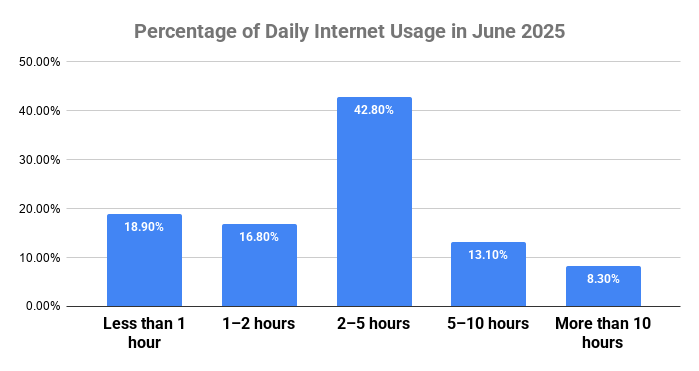
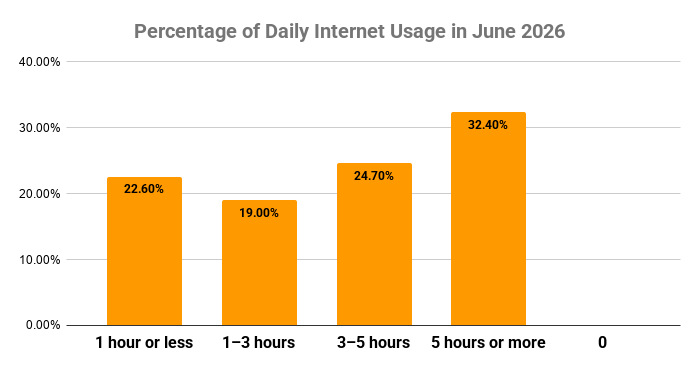
The two surveys indicate some changes in daily internet use, but differences in the way usage categories were defined make direct year-to-year comparisons difficult. In particular, the 2026 survey no longer separates users spending 5 to 10 hours online from those spending more than 10 hours, instead grouping them into a single “5 hours or more” category.
- The share of users who spend less than one hour online per day increased from 18.9% to 22.6%.
- The share in the next usage category also increased, from 16.8% to 19%, although the time ranges used in the two surveys are not directly equivalent.
- The largest usage category in 2025 was 2 to 5 hours per day, accounting for 42.8% of users. In 2026, the closest available category—3 to 5 hours—accounted for 24.7%, although the two ranges are not directly comparable.
- Meanwhile, 32.4% of respondents in 2026 reported spending 5 hours or more online. Because this category combines all usage above five hours, the survey does not show how many of these users spent more than 10 hours online.
These changes need to be understood in the context of Iran’s current internet environment. Users may remain technically connected to the network, but their ability to exchange data meaningfully and effectively is severely constrained. Connections repeatedly drop, pages are slow to load, and simply getting online can require repeated effort. Over time, this exhausting experience can wear users down and discourage them from staying online, leading some to give up and spend less time connected to the global internet. Others, if they can afford it, pay increasingly high prices for VPNs and other circumvention tools to maintain access.
Understanding the current state of internet access in Iran therefore requires looking at users’ everyday experience rather than relying solely on network traffic monitoring. As Filterwatch noted in its first report following the partial restoration of connectivity, “this is not a genuine reconnection to the world.” By reopening international gateways and traffic exchange points, the Iranian government can generate surface-level signals that make connectivity appear “normal” to automated global monitoring systems. Behind those signals, however, bandwidth remains heavily restricted. Users may technically appear to be online, while in practice their connection is slow, unstable, and repeatedly disrupted—an exhausting experience that gradually wears users down and can ultimately discourage them from trying to stay connected.
Another notable point in comparing the two ISPA surveys is the use of VPNs and other circumvention tools.
In the 2025 survey, 78.6% of internet users reported using either free or paid circumvention tools—63.4% used free tools and 15.2% used paid ones. In the 2026 survey, 74.4% of users reported using such tools. This roughly four-percentage-point difference should not necessarily be interpreted as declining demand for unrestricted internet access. Instead, it may reflect the gradual exhaustion of users facing persistent filtering—a pattern we have also documented in another Filterwatch report. As blocking methods have become more aggressive, some free circumvention tools no longer work as effectively as they once did, while access to more reliable options increasingly requires users to pay significant amounts.
The amount users spend on paid circumvention tools has also changed noticeably. In the 2025 survey, among users who paid for these tools:
- 56.7% spent less than 200,000 tomans per month (approximately $1.05).
- 18.3% spent between 200,000 and 500,000 tomans (approximately $1.05–$2.65).
- 2.5% spent between 500,000 and 1 million tomans (approximately $2.65–$5.30).
In the 2026 survey, the spending categories themselves were also changed. The findings show that:
- 18.2% spend less than 500,000 tomans per month (approximately $2.65).
- 6.3% spend between 500,000 and 1 million tomans (approximately $2.65–$5.30).
- 6% spend more than 1 million tomans per month (more than approximately $5.30) solely on circumvention tools.
The emergence of a group of users spending more than 1 million tomans a month illustrates how costly circumventing internet censorship has become for some Iranians. Under these conditions, access to the global internet is increasingly tied to users' ability to afford effective circumvention tools. This financial barrier may also be a factor contributing to the decline in the time Iranian users spend online.
The survey reveals another important point: despite intensified filtering, international internet shutdowns, and the growing cost and difficulty of accessing effective circumvention tools, the majority of Iranian users continue to use international social media platforms:
- 71.5% of users either use international social media platforms exclusively or use both international and domestic Iranian platforms.
- By contrast, only 24% use domestic platforms exclusively.
- Average daily use of international social media platforms is 2 hours and 5 minutes.
- Average daily use of domestic platforms is 1 hour and 37 minutes.
These findings suggest that filtering, internet shutdowns, and government efforts to push users toward domestic platforms have so far failed to drive Iranian users away from international platforms. Instead, these policies have primarily made access to those platforms more difficult and more expensive.
When the Response to Crisis Is More Control
While millions of Iranians were still grappling with the economic and psychological consequences of months of internet shutdowns, cyberattacks, disruptions to banking services, war, insecurity, and instability, Iran’s internet policy took a different direction in July. Rather than repair harm to users or strengthen the resilience of the country’s communications infrastructure, authorities introduced a series of measures to expand their control over the online space. These ranged from renewed emphasis on domestic infrastructure and more centralized internet governance to broader criminalization of online activity, expanded mechanisms for monitoring and prosecuting users, and the blocking of dozens of social media accounts.
A “Civilizational Vision” in Theory, Internet Filtering in Practice
On July 5, Iran’s Minister of Information and Communications Technology, Sattar Hashemi, published an article titled “The Martyred Leader’s Civilizational Vision for Cyberspace”. Ostensibly written to introduce Supreme Leader Ali Khamenei’s digital strategy to a younger generation, the piece serves as an important blueprint for the state’s long-term network strategy. It signals that government policy is fundamentally guided by two core priorities: expanding domestic digital infrastructure under centralized state control, and framing online connectivity as a battlefield for "cognitive warfare".
This ideological framework directly dictates everyday internet policy in Iran. In practice, the Minister’s vision translates into tighter user restrictions, the continued expansion of the isolated National Information Network, and aggressive content removal. Framing the internet through the lens of security and control justifies discriminatory access schemes, such as tiered internet access, "white SIM cards," and whitelisting, that grant preferential, unfiltered connectivity to select groups while leaving ordinary users heavily restricted.
New Threats of Prosecution for Online Activity
In another development this month, Iran’s Ministry of Intelligence, acting under the law titled “Intensifying Punishment for Espionage and Cooperation with the Zionist Regime and Hostile States Against National Security and Interests,” published a list of media outlets, online pages, and individuals with significant online reach—referred to in the directive as “human media”—that it classified as “hostile”. The directive set out a broad range of media and online activities that could result in criminal prosecution.
Under this directive, political, cultural, media, or promotional activities deemed to be “against national security” can carry prison sentences of more than 10 to 15 years and, in some cases, lead to charges of efsad-e fel-arz (“Corruption on Earth”), one of the most serious offenses under Iranian law. Sending videos, images, or information to the listed media outlets, social media pages, or influencers—or even to other media if the activity is deemed “against national security”—can result in five to 10 years in prison and a permanent ban from government and public services.
At the same time, on July 18, the spokesperson for Iran’s judiciary called on the Supreme Council of Cyberspace and other responsible bodies to report alleged online offenses to judicial authorities “without delay”. He identified the establishment of a dedicated “cyberspace monitoring” division within the Prosecutor General’s Office as a priority and called on citizens to use the Sajam reporting system to flag online content for the authorities.
A Quiet Purge of Instagram Accounts
In late July, Mahmoud Mohammadi, an official responsible for online content creators and digital activists in Kohgiluyeh and Boyer-Ahmad Province, announced the launch of a program to “organize” and regulate online actors in cooperation with Iran’s Ministry of Culture and Islamic Guidance. He stated that individuals active online would be identified and registered, and that those operating “outside the law” would face legal action.
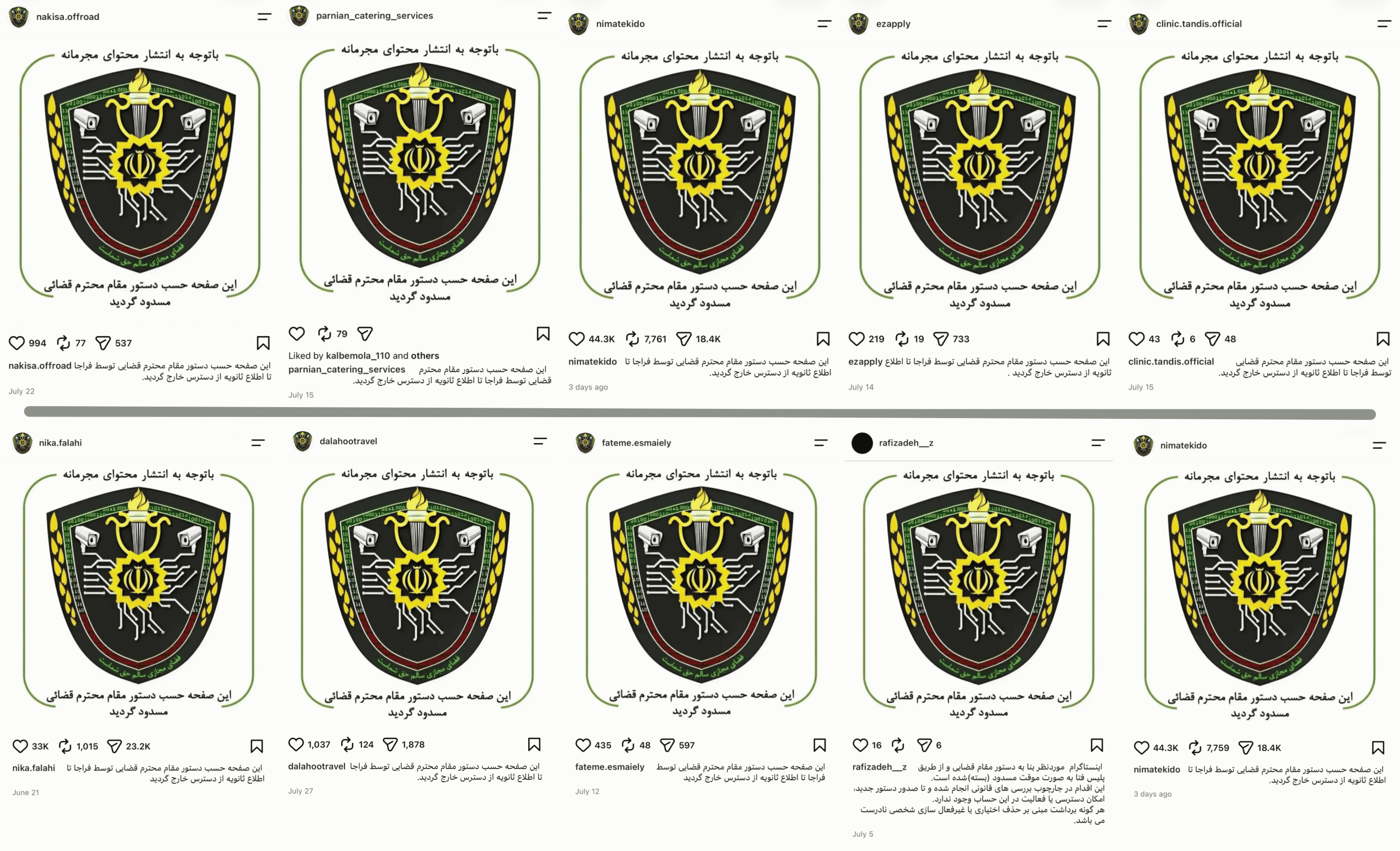
While no official details were released about the broader implementation of the program, the timing of the announcement coincided with a sudden wave of restrictions on Instagram accounts. Over the past month, dozens of accounts—ranging from ordinary individuals and local businesses to prominent influencers—were affected. Account holders were instructed by authorities to remove their existing content and publish a standardized notice stating that the page had been blocked by order of judicial authorities. The timing of these restrictions suggests that some of the new mechanisms for monitoring and restricting online activity may already be quietly underway.
2. Network Monitoring
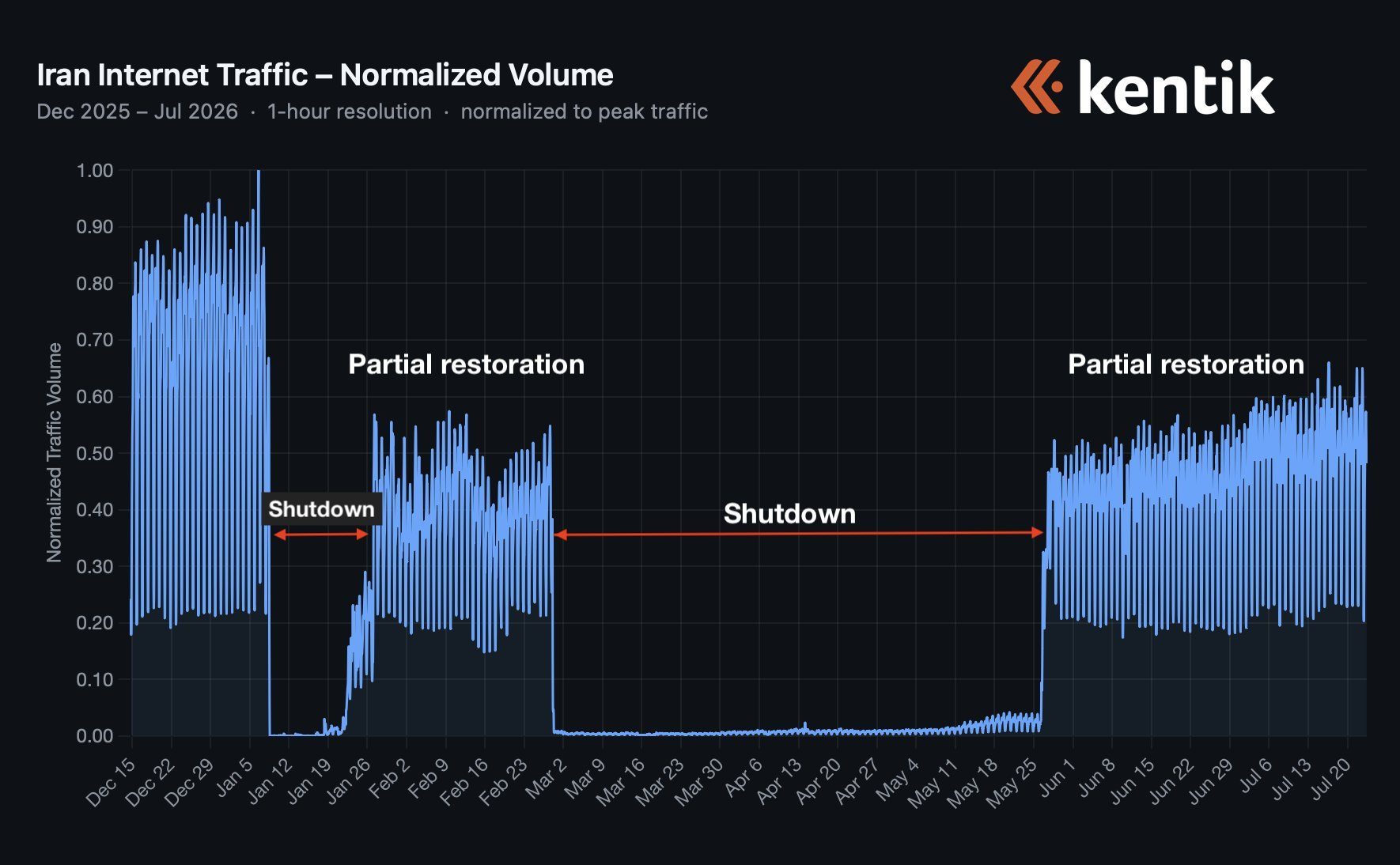
The latest data from Kentik shows that, as of July 23, 2026, internet traffic to Iran had still not returned to the levels recorded before the nationwide shutdown on January 8. Despite a partial recovery, traffic remained below pre-shutdown levels.
From War-Damaged Cell Towers to a Fragile Communications Network
In July, as military attacks intensified in southern Iran, users posted numerous reports on social media of internet and telecommunications disruptions across the country’s southern provinces. Following an airstrike in the early hours of July 17, fixed-line telephone, mobile, and internet services in Mamulan, Lorestan Province, were also disrupted or cut off.
At the same time, 116 telecommunications towers in Hormozgan Province were taken out of service due to airstrikes. According to officials, damage to traffic and bandwidth transmission lines disrupted telecommunications in northern Bandar Abbas and Hajiabad, temporarily cutting off fixed-line telephone, mobile, and internet services in parts of these areas.
Beyond disruptions directly linked to military attacks, Iran’s communications network experienced another major outage. On July 14, a failure in communications infrastructure provided by the Telecommunication Company of Iran caused widespread disruption to Asiatech services, leaving more than 120,000 residential subscribers and several thousand business customers in Tehran without internet access for hours. Asiatech attributed the outage to a failure in the communications infrastructure supplied by the Telecommunication Company of Iran.
Two Years of Unfulfilled Promises to Upgrade Backup Batteries
Beyond these incidents, one of the longest-standing weaknesses in Iran’s communications infrastructure remains unresolved: when the power goes out, internet connectivity often goes down with it.
As rolling power outages resumed in July, communications disruptions returned as well. Replacing backup batteries at telecommunications sites was supposed to help address this problem. However, Iran’s ICT minister acknowledged that the program has failed to prevent service disruptions and that during power outages lasting more than two hours, internet and telecommunications services inevitably become unavailable.
Promises to upgrade these batteries and improve network resilience have been repeated for at least two years. In practice, neither the power outages have ended nor has the country’s communications infrastructure been adequately adapted to withstand them. As a result, millions of users continue to risk losing internet access, telephone connectivity, and access to many digital services whenever the electricity goes out.
A New Form of Censorship in Iran
The most significant censorship and filtering incident in July involved Football 360, one of Iran’s most popular sports media platforms. On July 20, just minutes before a scheduled live broadcast, its website and app suddenly went dark.Without warning or public explanation, no government body took responsibility for the blocking, leaving the popular platform blocked without any formal legal explanation. What made this incident particularly notable was the method used. Rather than simply blocking internet traffic on its way to the site - a barrier users can usually bypass with VPNs, technical analysis revealed that the site's domain (football360.ir) was suspended directly at Iran's national .ir registry.
By deleting the site's address from the official directory, the platform became completely unreachable even for users with active VPNs or alternative DNS tools. This marks a troubling shift in state control: authorities are no longer just filtering access to websites, but using national domain management to wipe digital media from the internet entirely.
Appendix
1. Methodological Note
Comparison of Two ISPA Surveys on Daily Internet Use in Iran
Survey 1
- June 2025 (before the 12-day war)
- Commissioned by: Tehran E-Commerce Association
- Sample: 1,203 respondents — telephone interviews
- Target population: People aged 15 and older in urban and rural areas
Survey 2
- June 15–21, 2026
- Commissioned by: Ministry of Information and Communications Technology
- Sample: 4,060 respondents — in-person interviews
- Target population: People aged 15 and older in urban and rural areas
2. Methodological Explanation
The two charts in this report are based on two independent surveys conducted by ISPA. The studies are not directly identical: they differ in sample size, commissioning organization, and certain aspects of survey design.
However, these are the closest nationally representative ISPA surveys published one year apart that asked respondents about their daily internet use using broadly comparable time categories. Comparing the two therefore provides an indication of how patterns of daily internet use among Iranian users may have shifted over the course of the year.