
One month after the partial restoration of international internet access, internet policymaking in Iran remains heavily driven by security-driven narratives. Amid ongoing disputes over the source of recent cyberattacks, data centers' access to the global internet has still not returned to its pre–January 8 level. Furthermore, authorities are now conditioning server connectivity on opaque user authentication mechanisms and tiered access policies. This has sparked serious concerns regarding tighter state control over hosting infrastructure and the potential targeting of servers used to circumvent internet censorship. Iran’s internet ecosystem remains trapped at the intersection of domestic network control policies and international restrictions.
Key Findings
- Tighter Control Over Data Centers: Conditioning data centers' access to the global internet on user authentication requirements and tiered access structures has intensified server oversight, paving the way for targeted crackdowns on anti-censorship tools such as vpns.
- Persistent Disruptions to Banking Services: Despite the continued disruption of some banking services, the government has withheld public technical reports regarding the cause. Instead, these incidents have become a new battleground in the state's push for a National Information Network (NIN) over global internet access.
- Unstable Connectivity and Infrastructure Challenges: In addition to the restricted connectivity of data centers, the infrastructure’s low resilience has been further exposed by recent data center power outages and widespread GPS disruptions.
- Rising Internet Costs Amid Ongoing Restrictions: The Telecommunication Company of Iran (TCI) has altered its fixed broadband pricing structures, effectively raising the cost of access. This places a heavier economic burden on users at a time when internet quality and global accessibility remain severely restricted.
Policy Developments
1. Increased Oversight of Data Centers Under the Guise of User Authentication
More than a month after the partial restoration of international internet access, data centers in Iran continue to face unstable connectivity. To secure stable access, data centers are now being forced to comply with strict user-authentication mandates for server purchasers and customers, alongside tiered access policies.According to reporting by Digiato, authorities intend to track the identity of every purchaser of a server or data center service, the specific services they acquire, and the IP addresses they use.
If such a framework is implemented, it will grant the authorities highly granular control over internet traffic and hosting services. It will also allow maximum oversight and suppression of servers configured to run VPNs, proxies, and other censorship-circumvention tools. By requiring identity verification , authorities can pinpoint server operators and easily block access or impose selective restrictions.
This ongoing instability has left many online services and local businesses stranded in a state of limbo—unable to fully disconnect but unable to rely on stable global access.
2. Banking Disruptions: An Ongoing Crisis lacking Technical Transparency
Alongside these challenges, disruptions to banking and financial services, which began on June 13, have significantly impacted daily life and business operations. More than three weeks after major disruptions struck the online services of Bank Melli, Bank Saderat, Tejarat Bank, and the Export Development Bank of Iran, users continued to report persistent problems with some of their digital services. The incident quickly became a focal point in a broader debate over Iran's connectivity to the global internet.
Supporters of tighter internet restrictions argued that restoring access to the global internet exposed the country's critical infrastructure to cyberattacks, leveraging the incident to demand the expansion of the National Information Network (NIN) and further isolation of infrastructure from the global internet. Conversely, the Ministry of Information and Communications Technology rejected these claims.
Meanwhile, statements by government officials and members of parliament have offered conflicting narratives. The CEO of the Informatics Services Corporation (ISC) attributed the slow recovery process to the legacy architecture of Iran's banking systems, noting their reliance on IBM mainframe infrastructure that can take weeks to reboot due to their technical complexity.
Despite these statements, no public technical report has been published detailing the origin of the attacks, the exact vulnerabilities exploited, or the findings of official investigations. As a result,claims linking these disruptions to international connectivity remain entirely unverified by public evidence.
3.Hidden Price Hikes: Fixed Broadband Costs Rise Amid Altered Packages
Approximately eight months have passed since a 20% average tariff increase was slapped on mobile internet packages in the fall of 2025. Since then, Iranians have been paying higher premiums for degraded services, navigating severe global internet restrictions, shutdowns, and systematic censorship. In July 2026, the Telecommunication Company of Iran (TCI) introduced a new set of fixed broadband packages under what it describes as a "traffic volume revision." Although the company maintains that service prices have remained unchanged, media analysis indicates that reductions in data allowances and shortened contract terms have effectively driven up costs. For some fiber-optic packages, the cost to maintain previous data consumption levels has nearly doubled. Similarly, reductions in data allowances for ADSL plans means that users must purchase add-on data to maintain their previous usage levels. As a result, the effective cost of some ADSL packages has increased by approximately 50%.
These changes come at a time when fixed broadband remains more affordable than mobile internet in terms of cost per gigabyte. Nevertheless, the increase in the effective cost of access is likely to place additional financial pressure on households—particularly heavy internet users—and further widen the digital divide.
As Filterwatch has documented in past investigative reports, the state frequently masks internet cost increases. Instead of raising direct tariffs, authorities systematically alter package designs, shrink data allowances, modify contract periods, or degrade service quality to increase the effective cost of access without changing advertised baseline prices.
Network Monitoring
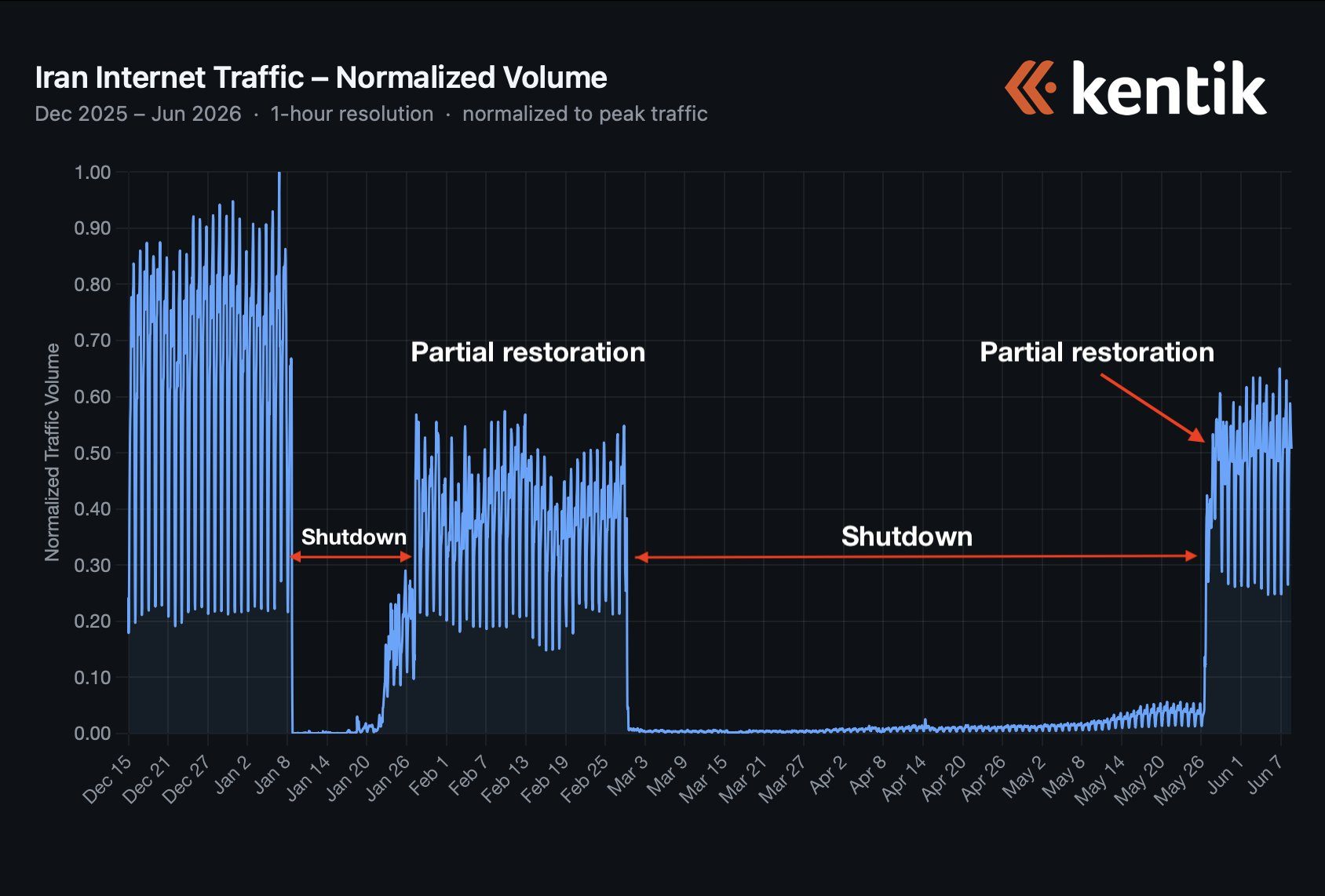
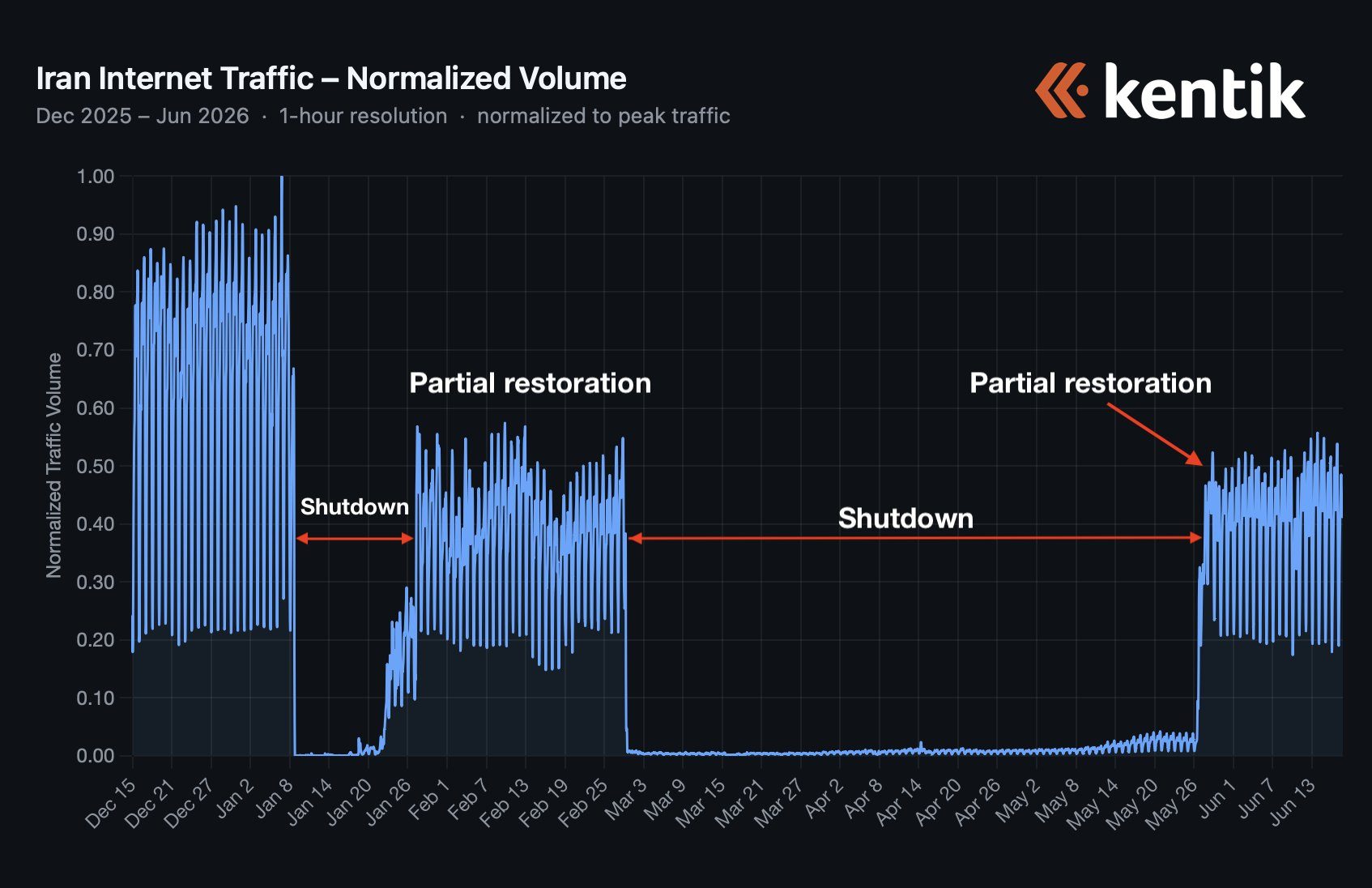
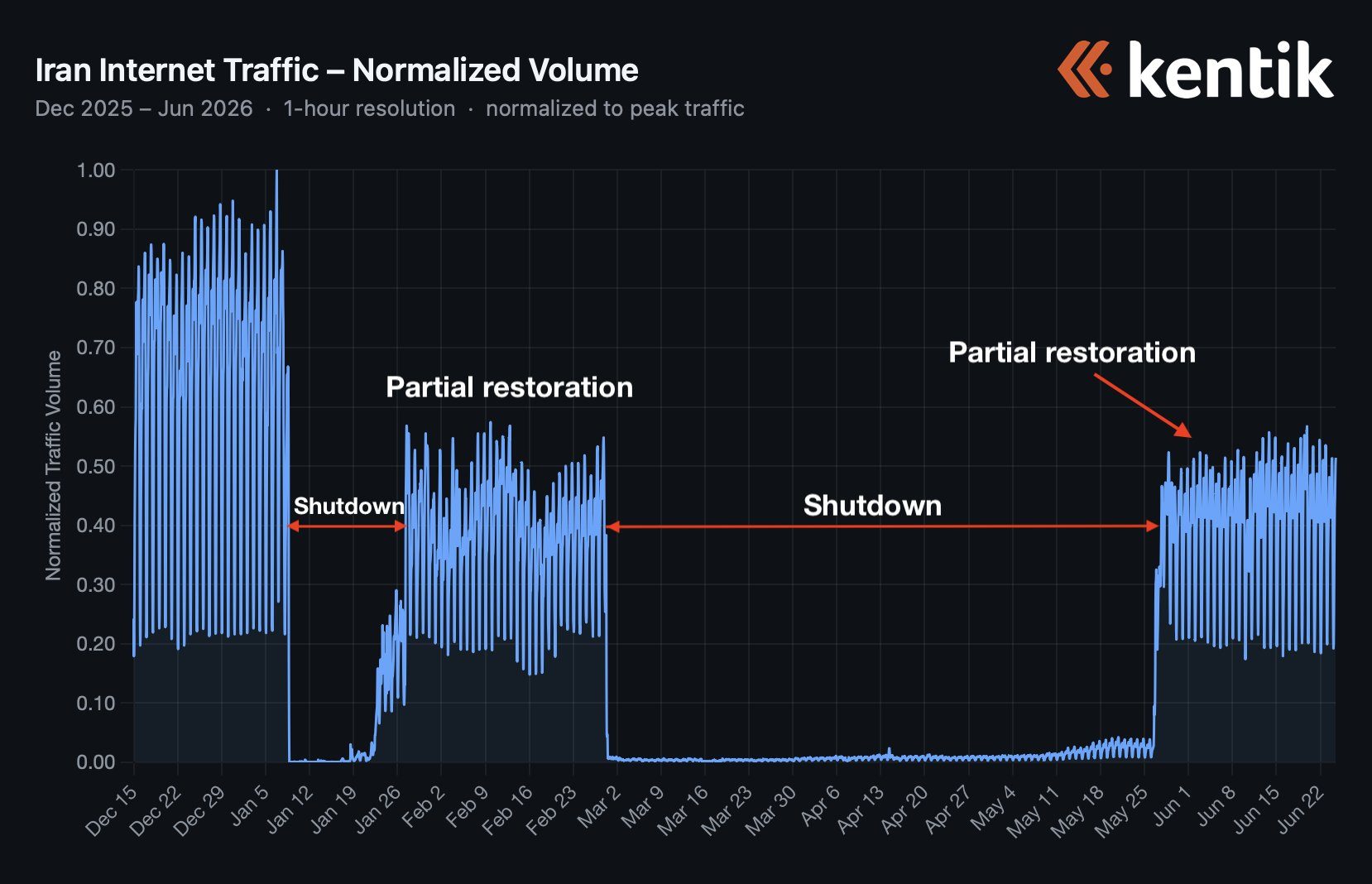
Despite the initial phase of internet restoration starting on May 26, network data from analytics firm Kentik shows that Iran's internet has remained stuck in a state of partial restoration. It has not returned to the baseline connectivity levels observed before the nationwide shutdown on January 8, 2026.
As shown in the June 8 chart, and as explained by Doug Madory in a post on X, nearly two weeks after connectivity began to be restored, Iran's international internet traffic peaked at approximately 60% of its pre-shutdown levels.
The subsequent June 17 and June 24 charts indicate that the recovery has plateaued, with international internet traffic remaining below normal baseline levels.
Simultaneously, domestic data centers' access to the global internet has yet to return to its pre–January 8 state. This instability has disrupted local hosting services, cloud infrastructure, and critical business infrastructure.
Compounding these connection issues, severe power grid failures have returned to plague data centers just as they did last summer. On June 22, the domestic messaging platforms Eitaa and Soroush Plus experienced widespread outages after a power failure at one of the Infrastructure Communications Company's (TIC) data centers.
Since late June, users nationwide—particularly in Tehran—have reported widespread disruptions to the Global Positioning System (GPS). Numerous user reports, together with confirmation from the Iranian navigation app Neshan, indicate that these incidents have spiked dramatically in the aftermath of the war.
In summary, developments over the past month suggest that the restoration of international internet access has not translated into a full recovery of network stability. With external bandwidth artificially suppressed, domestic data centers paralyzed by policy restrictions and blackouts, and localized GPS interference climbing, the overall resilience of Iran’s digital infrastructure is facing its most critical vulnerabilities to date.