
In November 2025, Iran’s internet policy accelerated its trajectory toward a system defined by high costs for the majority, and privileged, unfiltered access for a select few. This widening gap is the primary driver of a deepening digital divide, structural discrimination, and expanding state surveillance. Rather than addressing the root causes of network issues, authorities focused on punitive measures and data centralization, reinforcing the internet’s transformation from a public utility into a guarded, two-tiered commodity.
The most critical developments in Iranian internet policy and network status during the November 2025 reporting period include:
- Access Costs & Inequality: 20 - 29% price hikes: Mobile data packages saw average price increases of 20-29%, placing an additional burden on the majority of users. This signals another step in a years-long policy of raising access costs, removing affordable packages, and pushing users onto the National Information Network (NIN) , all without meaningful improvements to network quality.
- Control & Misdirected Policy: Evasion of Root Causes: Parliament launched an investigation into the $200–500 million black market for VPNs rather than addressing the restrictive filtering policies that created the market.
- Return of Punitive Legislation: The controversial “Countering False Content” bill resurfaced, proposing harsh penalties such as imprisonment, fines, and platform suspensions.
- Surveillance & Centralization: Expanded Data Aggregation: Data centralization is accelerated through major government projects like IranPars, electronic ID documents, and GNAF’s 16% expansion, all taking place in the absence of a comprehensive data protection law.
- Network Fragility: Network Disruptions: A Cloudflare outage coincided with a breakdown on the Armenia route, sharply revealing the fragility of Iran’s international connectivity and disrupting access for Iranian users.
Mobile Price Hikes widen the Digital Divide
Iran’s two major mobile operators, Hamrah-e Aval (MCI) and Irancell, announced that a new round of price increases for mobile data packages would begin on 2 December 2025, with an average rise of 20 percent. While this rise applies to both international and domestic internet packages, domestic rates remain significantly lower to ensure they stay more accessible. One day later, Rightel also declared that its data packages would become 29 percent more expensive.
These hikes align with the Islamic Republic’s broader internet policy: raising access costs and expanding restrictions to steer users toward the NIN. By keeping domestic packages cheaper, the government financially incentivizes the use of the intranet over the global web. This policy shift comes just ten days after the exposure of “white SIM cards,” which provide privileged, unfiltered access to select groups. The result is a dual-layered system: while the general public faces rising costs for restricted access, a specific minority maintains unrestricted connectivity, further widening the country's digital divide.
As ordinary users face rising costs, the removal of affordable packages, and the burdens of extensive filtering, these price increases place additional pressure on the majority of society. Meanwhile, the preferential treatment of a small class of users whose roles or behavior align with centers of power continues uninterrupted. This is happening despite the lack of measurable improvement in network quality. Even parliament’s Oversight Office confirmed that the Ministry of ICT fulfilled only 29% of its mandated duties during the first year of the Seventh Development Plan.
The latest report from the Communications Regulatory Authority (CRA) on the ICT sector in summer 2025 shows that more than half of all user complaints relate to service outages, disruptions, and lack of access. Another concerning trend is that, despite expanded fiber-optic coverage and an increase in FTTH’s market share from 4 to 7 percent, fixed broadband has failed to gain a stable foothold, pushing users further toward mobile internet meaning that the new price hikes will hit them even harder.
In separate statements, operators attributed the increases to structural factors including rising network maintenance and development costs, inflation, currency fluctuations, sanctions, and the need for major infrastructure investment.
Filterwatch’s earlier report showed that from winter 2022 to summer 2024, both fixed and mobile data packages experienced repeated price hikes, with a formal 34 percent increase in mobile internet prices adopted in January 2024. Meanwhile, operators have reduced the availability of high-volume packages and limited package diversity especially under policies like CRA Resolution 266, which differentiates domestic and international traffic effectively raising user costs and transforming the internet from a public utility into a luxury commodity.
Ignoring the Root Cause: Investigating VPNs Over Filtering Policy
The recent remarks by the Speaker of Parliament on the supposed balance between filtering, governance, and regulation in cyberspace underscore the ongoing confusion among policymakers. On one hand, officials including government representatives repeatedly promise the lifting of filtering; on the other, their insistence on “governance” and “regulation” of cyberspace leaves no path forward except maintaining extensive censorship.
Mohammad-Bagher Qalibaf described last year’s 32-article resolution of the Supreme Council of Cyberspace as the regime’s definitive “governance and regulation framework” for the digital sphere. This same document conditions the unblocking of foreign platforms on relocating their servers inside Iran, a requirement that is, in practice, impossible to meet.
Recent news surrounding the potential unblocking of Telegram further demonstrates the impracticality of demanding that foreign platforms host their data domestically.
On 18 November, Parliament announced that its negotiating team had concluded initial discussions with Telegram and passed the results of these preliminary agreements to domestic authorities. The matter, they said, now rests with the Supreme Council of Cyberspace, which must decide whether to accept or reject the proposed terms. One week later, MP Rasai reported citing the Ministry of ICT that no foreign platform is willing to host its data inside Iran, effectively extinguishing any realistic hope for Telegram being unblocked.
Throughout this period, digital rights experts have repeatedly stressed that any conditional unblocking, tied to the Council’s six governing requirements and the demand that platforms become “governable,” fundamentally contradicts principles of free expression and digital privacy. Nevertheless, the Speaker continues to insist that the prospect of unblocking Telegram is still “under review.”
Meanwhile, Mohammad-Jafar Ghaempanah, the President’s Executive Deputy, has stated plainly that “filtering decisions are made by the Supreme Council of Cyberspace, not the government alone. We can propose, pressure, and argue and we have done all of that but we cannot implement anything unilaterally.”
Amid these unresolved contradictions, Parliament took a new step on 25 November, voting in favor of a plan to investigate the governance of national data gateways and to identify mechanisms that enable circumvention tools such as VPNs effectively launching a formal inquiry into this area.
Filtering policies are the root cause of rent-seeking, discrimination, a stagnant digital economy, and the $200-500 million VPN black market, imposing heavy costs on nearly 60 million users. Authorities, however, are focused instead on tracking down the VPN market—in search of the proverbial orange seller—rather than addressing the fundamental restrictive laws.
Return of the Controversial "Countering False Content Publication in Cyberspace" Bill
Alongside the news of price hikes, continued filtering, and discriminatory access policies, November also saw the controversial “Combating the Publication of False Content in Cyberspace” bill return to the government’s agenda. This bill originally withdrawn by the government from parliament in August 2025 under the pretext of “preserving national cohesion” is now, according to the government spokesperson, back under review as of 12 November, with a special task force examining its various dimensions.
While officials claim the bill’s main purpose is to “support media professionals” and improve accuracy in information dissemination, a look at its earlier draft reveals provisions for harsh penalties including imprisonment, fines, dismissal from public service, and suspension of publishing platforms which have little to do with support and instead clearly reflect an approach of maximum oversight and punitive control. With the bill once again under examination, it remains unclear what changes, if any, the new version will include.
Centralization of National Data and the Expansion of State Surveillance
In November 2025, several major policies and projects were announced by the Ministry of ICT and the Information Technology Organization initiatives that all point toward greater aggregation of national data, centralization of identity and location information, and expanding the state’s capacity to monitor citizens. Mohammad-Mohsen Sadr, head of the Information Technology Organization, revealed the government’s new plan to create “digital government ecosystems,” the national “IranPars” project (which converts citizens’ identity documents into electronic records), and new guidelines for establishing cybersecurity operators for government agencies.
At the same time, the announcement of a 16% increase in the completion of the national spatial information database (G-NAF) is particularly significant. By linking postal codes, geographic coordinates, and descriptive data of locations, this project creates a highly detailed and traceable layer of spatial–identity data accessible to the government.
These centralized, data-driven systems can streamline service delivery, but they also dramatically expand the state’s ability to monitor, intervene in, and analyze citizens’ information. In many countries, similar projects are allowed only under strict data protection laws and the oversight of independent regulatory bodies. In Iran, however, the absence of a comprehensive data protection law leaves initiatives like G-NAF in a gray zone between digital governance and a surveillance-oriented state.
International Connectivity: Outages and Disruptions in November
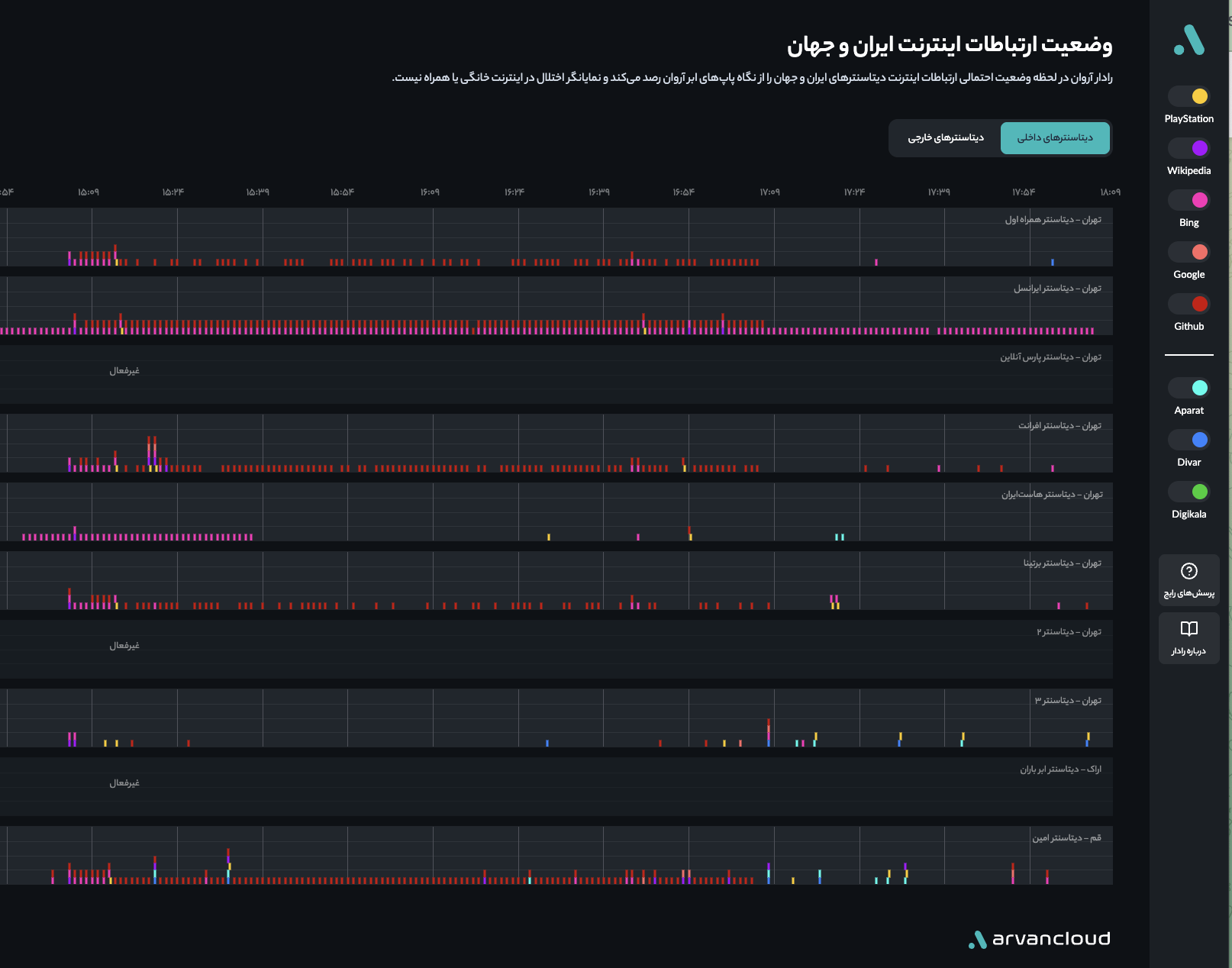
In November 2025, network measurement tools detected limited disruptions in Iran’s internet connectivity. As in the previous month, the longest-running issue was linked to the Tehran–Irancell datacenter—an interruption that has continued since last month, with a low but persistent impact on access to international routes, including the Bing path, as reflected in ArvanCloud’s Radar charts.
Two additional developments are noteworthy on Cloudflare’s graphs this month:
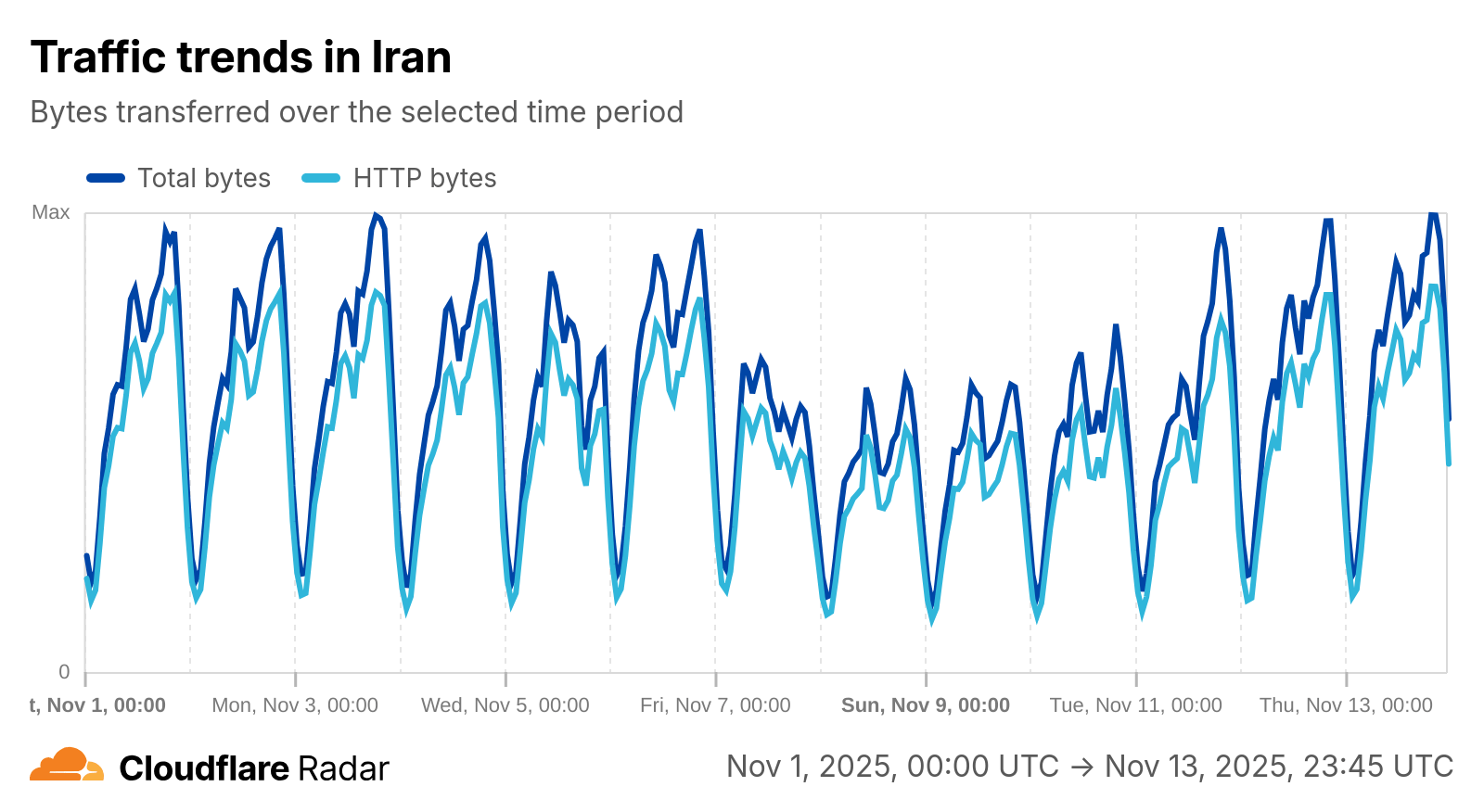
1 — A sharp drop in Iran’s internet traffic (7–9 November)
Cloudflare data shows that between 7 and 9 November, Iran’s internet traffic experienced a decline of more than 40 percent. This disruption is clearly visible in the “Total bytes” and “HTTP bytes” indicators and resulted in a noticeable reduction in speed and quality of access for Iranian users during that period.
In response to public questions, Behzad Akbari, CEO of the Telecommunications Infrastructure Company, stated that “there is no issue within Iran’s domestic infrastructure, and the drop in traffic was due to a global Cloudflare outage.” He added that because a significant share of Iranian traffic depends on Cloudflare’s services, the impact of such disruptions is more visible inside Iran.
To verify this claim, Filterwatch consulted an independent Cloudflare expert. The expert provided a different picture: he noted that there had been no global outage on Cloudflare’s network, although the unusual traffic pattern for Iran on Cloudflare Radar was confirmed. According to him, while the number of HTTP requests remained almost constant, the volume of transferred data (bytes) had decreased. Since indicators related to connection tampering—such as TCP resets or timeouts—showed no significant changes, bot traffic remained stable, and no holidays or major events occurred that could explain a sudden behavioral shift, the expert suggested that the anomaly may have resulted from traffic restriction, altered routing, or enforced compression on the Iranian side.
2 - The 18 November Cloudflare outage and simultaneous disruption on Iran’s Armenia route
On 18 November, a major outage occurred across Cloudflare’s services due to an unexpected expansion of a configuration file. This incident took platforms such as X, ChatGPT, and numerous other websites offline worldwide and Iranian users were also affected.
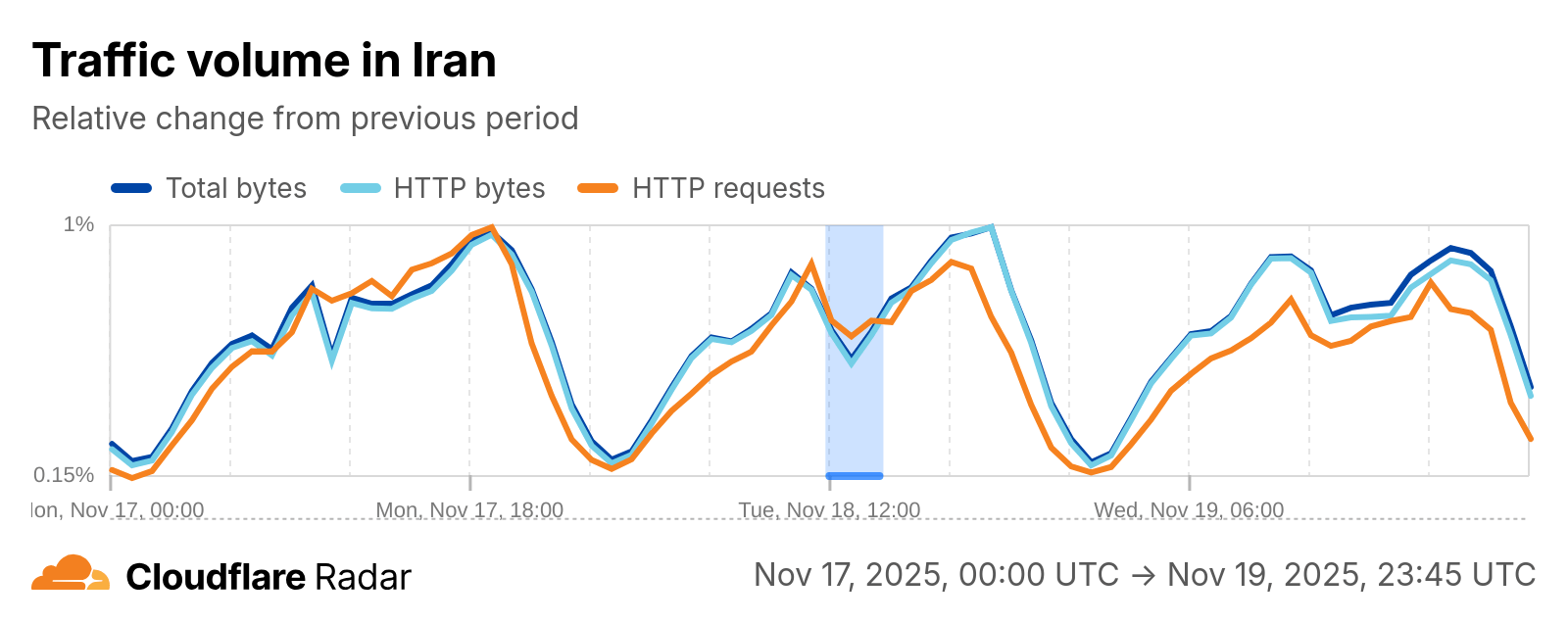
At the same time, Behzad Akbari, CEO of the Telecommunications Infrastructure Company, announced that in addition to the global Cloudflare disruption, an internet outage had occurred on Iran’s Armenia route that same day, which further affected the country’s international connectivity.
ArvanCloud’s Radar charts also show clear signs of disruption in access to international traffic during that period.
Over the past month, Iran’s internet policy has shifted further toward higher costs, stricter controls, and deeper structural inequality, marked by 20–30% mobile price hikes and continued privileged, unfiltered access for a select few. Meanwhile, the state accelerated data centralization and revived punitive digital regulations. Network disruptions, including the Armenia-route outage, again revealed the fragility of Iran’s international connectivity. Overall, the current trajectory widens the digital divide and reinforces state surveillance rather than improving access or quality.