
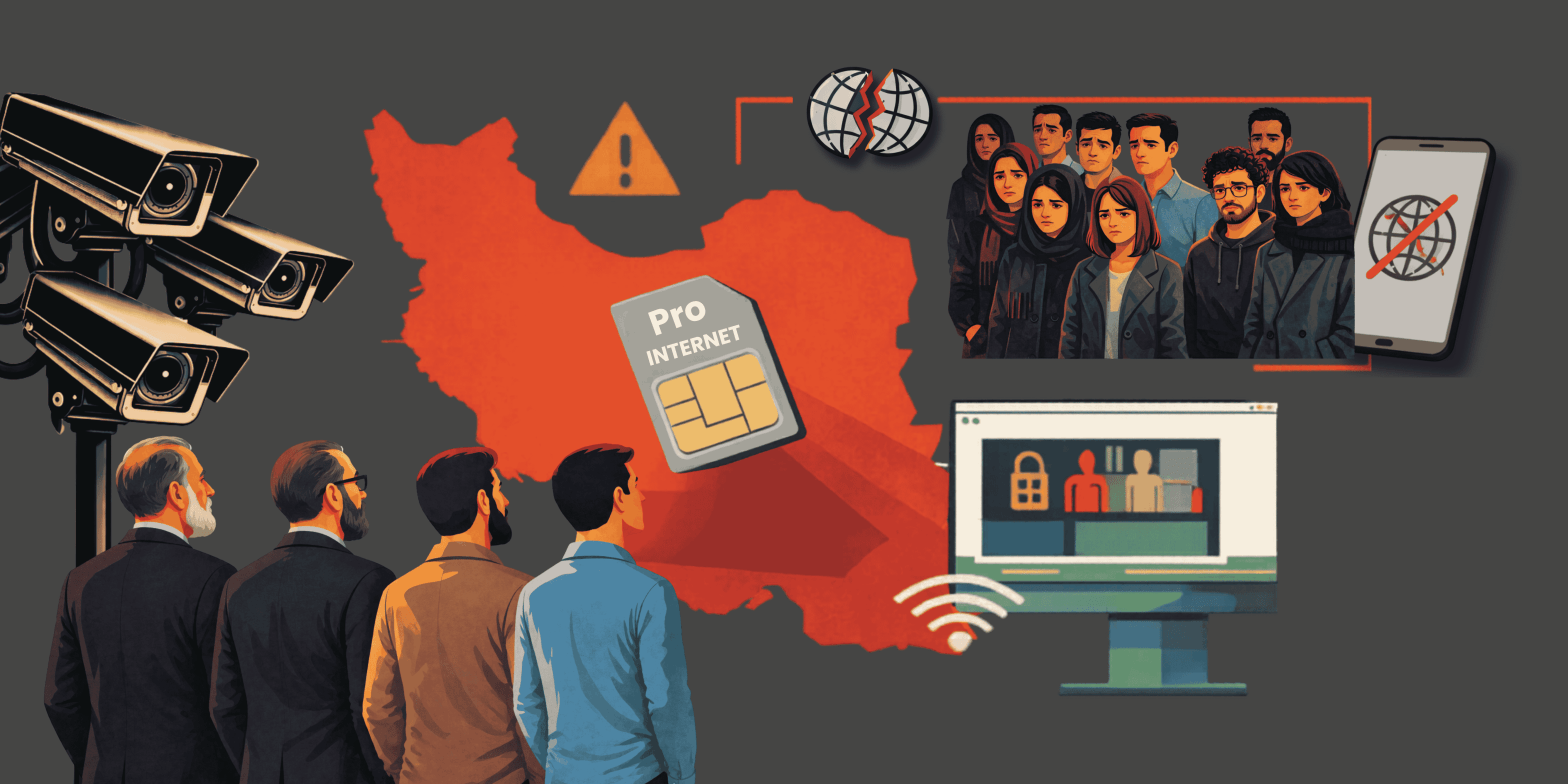
The Islamic Republic of Iran is entering a new era of digital authoritarianism with the role of a long anticipated, discriminatory system of internet access. On April 14th, Sattar Hashemi, the ICT Minister, unveiled the government’s plan in an op-ed for Shargh daily using terms like, “internet sovereignty,” "strategic infrastructure," “digital governance,” “stable communications,” and “global connectivity." But underneath Hashemi’s neutral sound technocratic language was a stark declaration, Iran wants to permanently shut down all public access to all international internet, and instead only allow selective access to special users.
Until now, Iran’s policy approach was to provide the general public connectivity to the global internet, increasingly subjected to heavy censorship and case-by-case blocking over time. Simatanouly, Iran was building its own domestic intranet, the National Information Network (NIN), complete with domestic tools, services, and infrastructure. As outlined in a January 2026 Filterwatch report, that model is gone and replaced by a policy position that public access to the global internet should default to disconnection, or the most severe restriction, and that only specific groups, institutions, or licensed users should be able to access global internet content and communications platforms. Under this strategic framework, internet access is no longer considered a public service or right for all citizens and residents of Iran, instead it is now a government-granted privilege. Access is calibrated according to security considerations, economic demands, governance objectives, and top-down priorities. Moreover, even privileged users are likely going to be burdened by fees. This new framework has shifted the Islamic Republic’s information controls away from classical censorship and towards a discriminatory architecture, with the majority of users being kept solely within Iran’s restricted, highly surveilled, and tightly controlled NIN.
The first commercially available product under this policy framework is Internet Pro. To obtain Internet Pro, a user must first meet the eligibility criteria (such as having a business, an operating license, or a commercial card) and then apply through telecom operators. This process involves accessing the operators’ dedicated portals, submitting personal and business identification details, and completing a “secondary authentication” step in which the applicant’s national ID is matched with the SIM card owner, along with providing documents such as a business license or an economic code. In some cases, such as for merchants, submitting an in-person request at the Chamber of Commerce and providing an address is also required. After approval, the user is granted access based on a specific IP (often static), and by accepting responsibility commitments, the service is activated; a service that offers a different level of access to the global internet. Moreover, the access will be fully monitored and traceable.
Internet Pro’s privileged access is very selective, factoring in a user's security authorization, professional status, economic needs, education, age, gender, and other governance criteria. For example, three individuals using Internet Pro from the MCI operator confirmed that as of April 4, 2026, access to the messaging service WhatsApp has been enabled due to “business needs,” while access to Telegram remains unavailable. This selective access, however, can go much farther in the future. Theoretically, authorities could decide that Iranian news outlets could have access to all international media and publications but hospitals should only have access to online medical journals. Authorities could even allow men to only access information about men’s health, and women to only access information about women’s health.
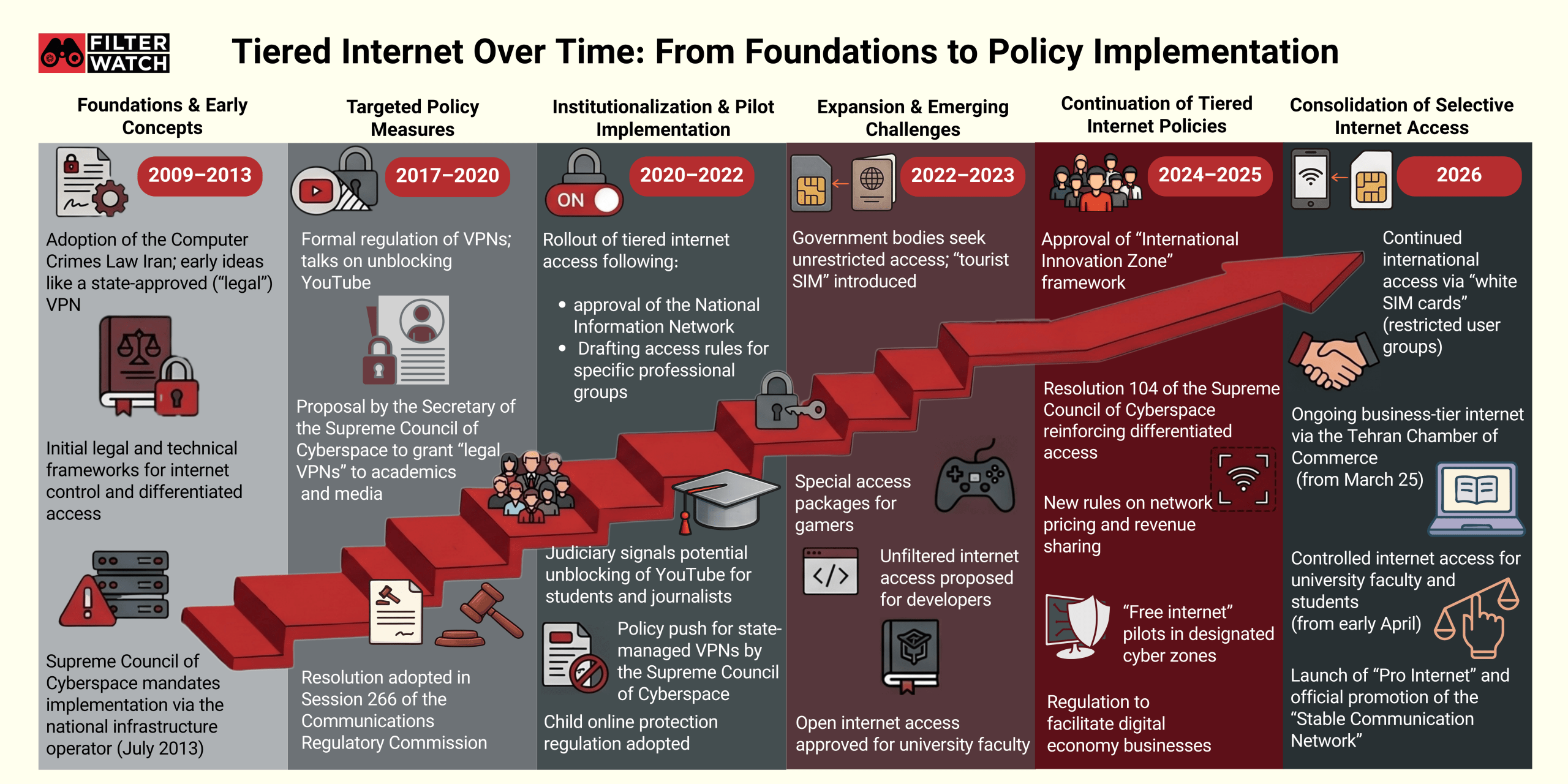
To understand Internet Pro, one cannot look only at its current form or the packages offered by operators. Internet Pro is neither a sudden decision nor merely a commercial service; rather, it is the latest configuration of a project that the Islamic Republic has pursued for years under various names and justifications. What is now presented as “Internet Pro” is the result of a multi-year trajectory developed by Iran’s top regulator, the Super Council for Cyberspace. The policy framework has been called “Tiered Internet,” or “Legal VPN” and cemented in a series of resolutions, but the core idea has remained the same: limit the public to content and platform housed on the NIN, while minimizing negative impact on government functions, national security, economy and businesses, science and health sectors, and other knowledge sectors (i.e., academia, research, and journalism).
As such, Internet Pro is not merely a side product or revenue source for operators; rather, it is a prototype of the future internet in Iran. It represents a model in which the government learns how to simultaneously keep the majority of society within a restricted digital space while providing selective, controlled exceptional access for chosen minorities. This model allows the government to meet parts of the country’s economic and institutional needs without returning to a public internet, while at the same time deepening the project of digital isolation.
What is taking shape in Iran is not merely intensified censorship, but the emergence of a new phase of digital repression in which the very concept of an open and universal internet is redefined—against the interests of the majority of citizens and residents. This model allows the government to meet parts of the country’s economic and institutional needs without returning to a public internet, while at the same time deepening the project of digital isolation. This policy transformation should be viewed alongside the quarantining of professional communications, countermeasures against Starlink satellite internet, and even restrictions on roaming beyond national borders as part of a broader security reconfiguration.
Iran’s experience is not merely a domestic issue. The Islamic Republic essentially evolved the model of internet sovereignty seen in China and Russia to the maximum level of global internet disconnection, only off-set by a glaring form of structural discrimination. If this trajectory continues in Iran and elsewhere, open connectivity will no longer be a universal right, but a privilege dependent on authorization, status, and security desirability.