
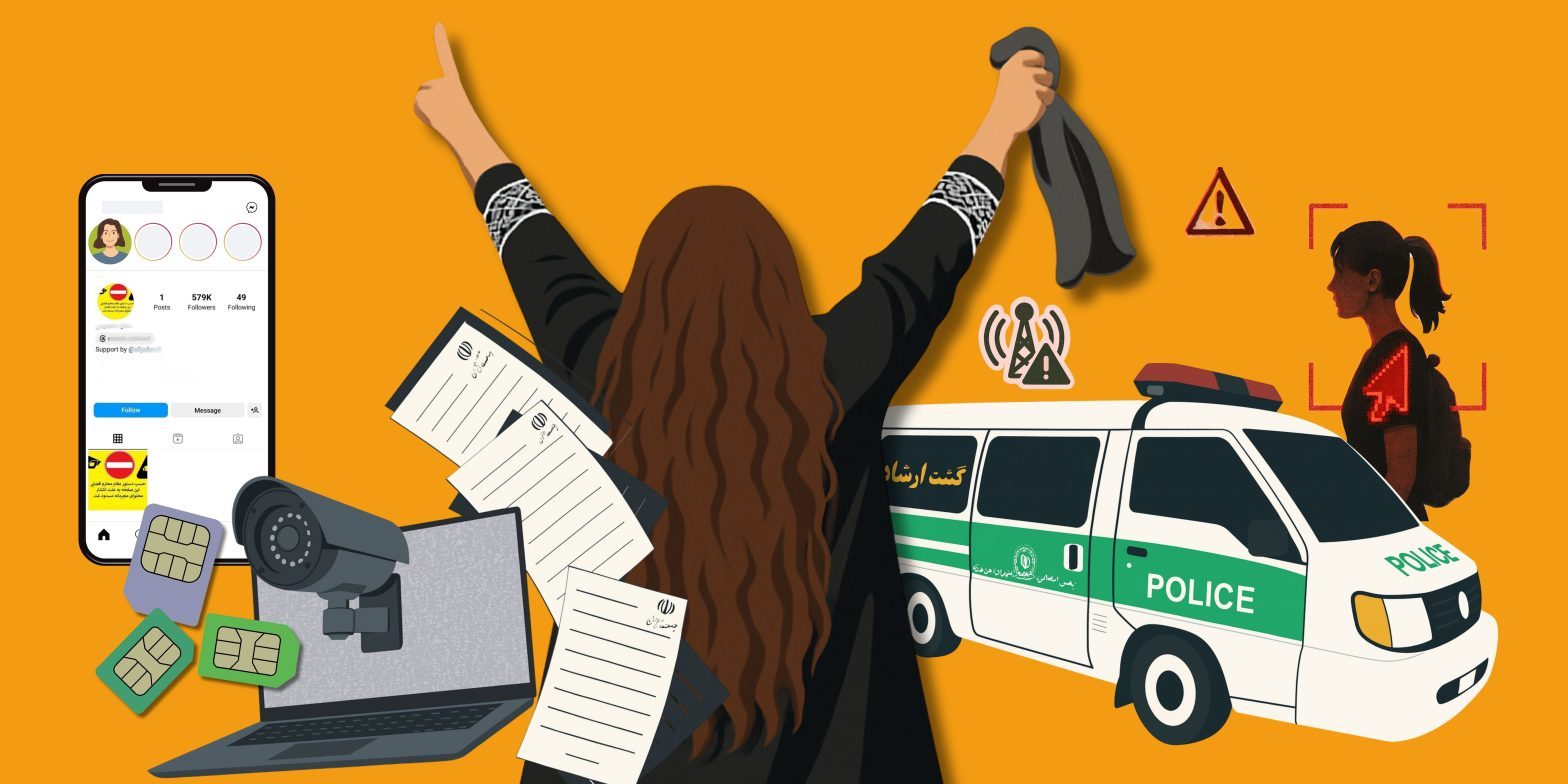
In recent months, the patrol vans of the "Guidance Patrol"—the most visible symbols of Iran’s street-level hijab enforcement once used to stop, warn, detain, and transport women accused of violating compulsory dress codes—have largely faded from public view. While this has led some observers to believe that pressure on women is easing, the reality is far more insidious. Enforcement is not disappearing; it is being redesigned.
This report argues that the Islamic Republic is pivoting from costly and high-visibility physical control toward quieter, digitally mediated mechanisms of repression. In place of batons and patrols, authorities are leveraging new administrative processes, digital infrastructure, and platform-based regulation. These methods are less conspicuous but potentially more scalable, allowing authorities to exert influence while minimizing the political risks associated with overt street repression.
Drawing on data from the Miaan Digital Security Helpdesk alongside recent legislative shifts,, this investigation examines how compulsory hijab enforcement is evolving into a model of data-driven governance, one that shifts control from public confrontation to continuous monitoring, economic leverage, and digital intervention. Far from signaling retreat, this transformation reflects a strategic recalibration shaped by tensions between state institutions concerned with social stability and ideological bodies seeking to preserve a rigid normative order.
Silencing Voices and Screens: A New Pattern of Pressure Against Women Online
1. SIM Cards That Are Blocked Overnight
The suspension of mobile SIM cards has intensified in recent months and is no longer limited to civil society activists. Filterwatch has obtained data indicating that women who do not conform to the Islamic Republic’s prescribed dress codes or lifestyle expectations have also become targets of this measure.
The first reports of SIM-card suspensions emerged in mid-October 2024, when several journalists and civil society activists in Iran saw their mobile lines abruptly cut off. These incidents suggested that the authorities were testing and gradually implementing a new method of repression against critics and dissenting voices. According to data recorded by Miaan’s digital security helpdesk throughout 2025, more than 20% of all reports documented as threats against citizens involved SIM-card suspensions. While 13.6% affected political and civil activists and journalists, nearly six percent targeted ordinary citizens who had merely shared content on their personal social media accounts that diverged from the government’s preferred lifestyle narrative.
SIM-card suspensions effectively force individuals to engage directly with security authorities to regain access to essential services such as banking, education, and communication. In practice, this mechanism compels citizens to appear before security bodies without formal summonses or arrests.
According to information obtained by Filterwatch, particularly after the 12-day June conflict, many users whose SIM cards were blocked were instructed to contact a specific phone number via the domestic messaging platform Eitaa. They were required to sign forms pledging not to publish content deemed contrary to state policies and, in some cases, to commit to posting material aligned with official narratives.
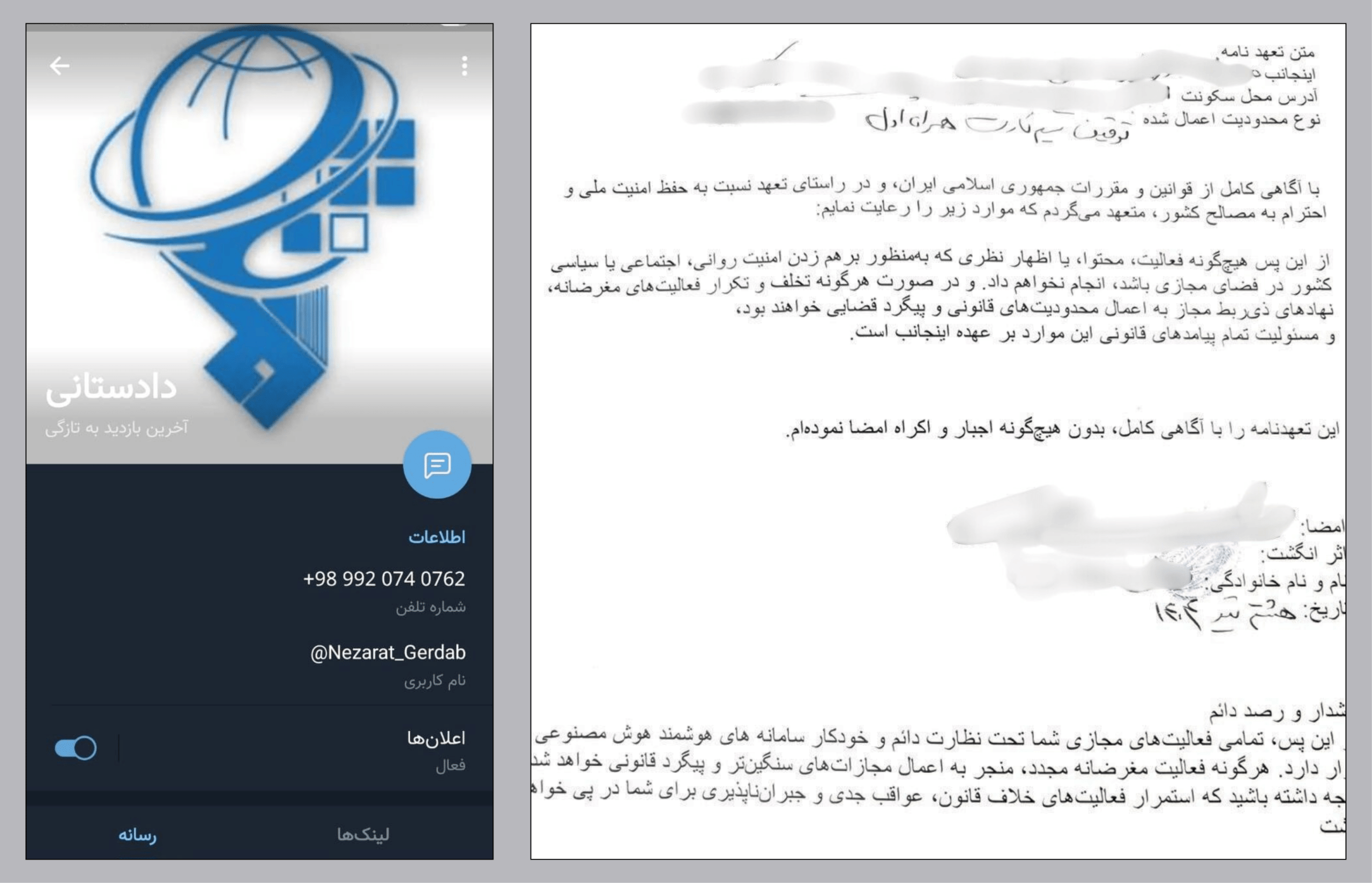
In other instances, individuals were reportedly asked to delete their social media accounts entirely and refrain from online activity for a period of time. Filterwatch has also learned that, in certain cases, account holders were subjected to financial penalties of up to 80 million rials (approximately the equivalent of several hundred US dollars).
2. Sudden Suspensions: Women Disappearing Overnight from Social Media
Until recently, digital repression in Iran followed a visible script: Cyber Police (FATA) warning banners or formal notices on pages stating an account "violated regulations." Today, that script has evolved into a more absolute form of censorship: the total seizure of accounts and the abrupt erasure of women from digital platforms. A prominent recent example is the Instagram page of the singer Evi, which was taken offline and rendered entirely inaccessible without prior warning.
Data from Miaan’s Digital Security Helpdesk confirms that this pressure on women has intensified in recent months. Between February and June 2025, we recorded 18 high-profile cases of Instagram accounts belonging to women artists—musicians, photographers, and comedians—being shut down under judicial orders. This was followed by a more targeted wave in late 2025, where approximately 30 women rappers and those active in the music scene across several provinces, including Mazandaran, lost their accounts in a matter of weeks.
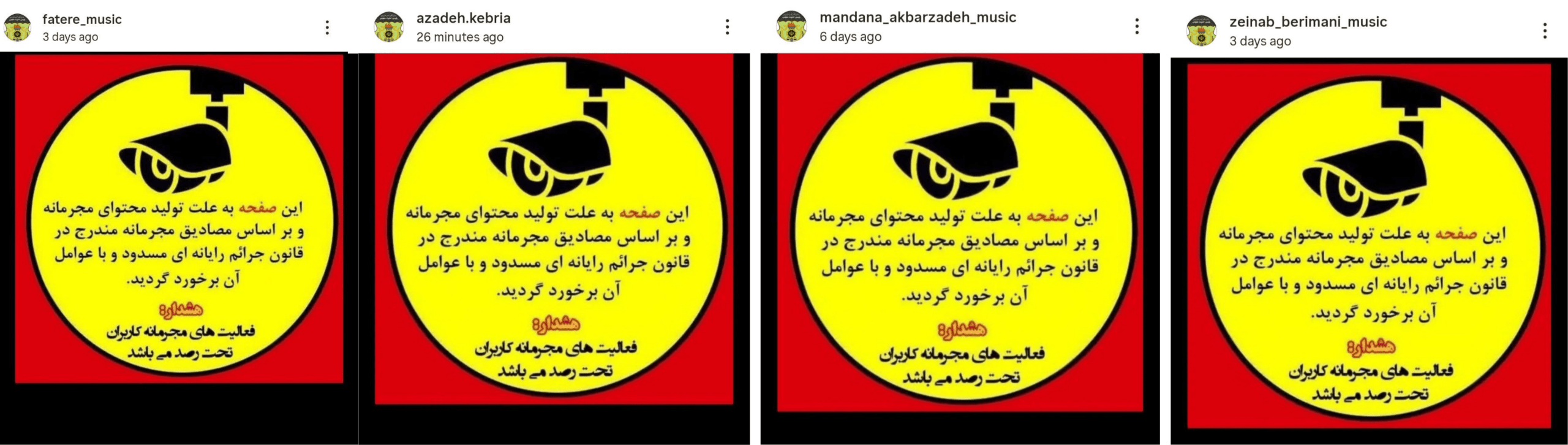
This "account blocking" is no longer just about policing dress; it is a mechanism for systemic silencing, erasing women’s public presence in the arts, and disrupting their professional pathways. The suspension of women’s accounts has also expanded to other platforms: while Instagram was previously the primary target, Miaan’s data indicates that in the second half of 2025, account suspensions on the social platform Threads increased by 45 percent.
At a time when women make up more than half of Instagram-based shop owners, content creators, models, fitness coaches, and small-business administrators in Iran, shutting down a page is not simply the removal of an account; it can mean an abrupt loss of income, the collapse of customer networks, and the destruction of accumulated social capital. Perhaps for this reason, many Instagram-based businesses have felt compelled to repeatedly declare their “commitment to observing national regulations” to continue operating.
Authorities frequently justify these actions using labels such as “promoting improper hijab,” “indecent exposure,” “immoral modeling,” or “vulgarity,” targeting pages belonging to beauty salons, dance and fitness instructors, fashion boutiques, beauty and lifestyle bloggers, and even corporate promotional accounts. Page owners have been summoned, interrogated, fined, or threatened with imprisonment and legal prosecution. As a result, many women have been forced to censor their content, switch accounts to private, avoid showing faces or human models, or withdraw from active participation online altogether, a retreat that amounts to the gradual removal of women from the storefront of Iran’s digital economy.
3. Economic Pressure: Using License Revocations as Leverage
In one of the latest examples of economic pressure used to enforce mandatory hijab, the business license of Pindo, a platform affiliated with Digikala (E- Commerce platform) was revoked following a Yalda celebration (a traditional Iranian winter solstice festival) where men and women were reportedly present together without observing compulsory dress codes. Its CEO was also sentenced to 74 lashes.
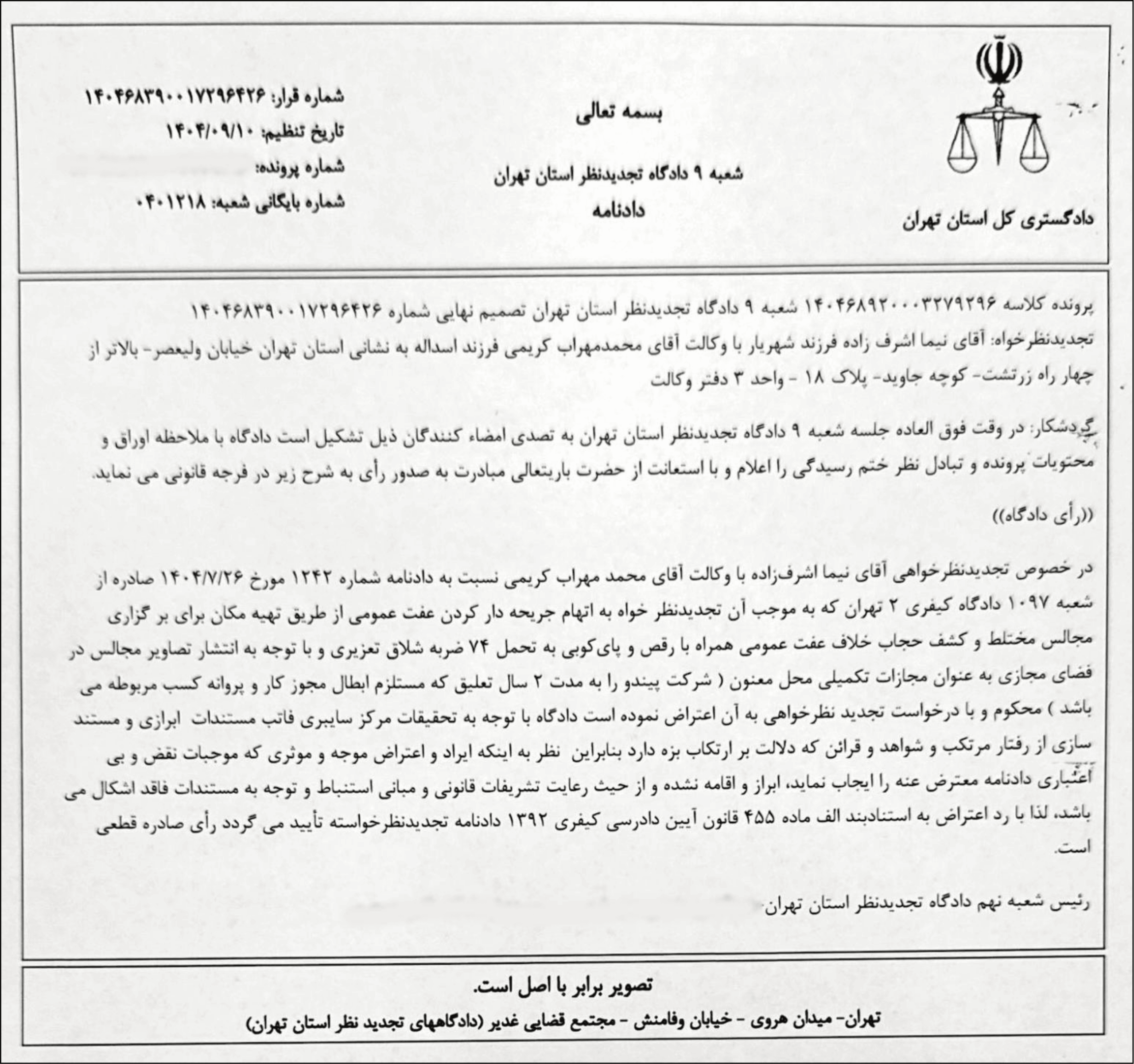
Amid Iran’s current economic instability, financial pressure has become a powerful tool for silencing dissent against mandatory hijab policies. This approach systematically raises the cost of resistance, while the full scale of its impact, particularly on women who are quietly removed from public and professional spaces without media attention, remains largely undocumented.
Reports have also emerged during the second academic term indicating that universities across the country, including institutions in Yazd and Tehran (Sharif University), have contacted students’ parents regarding alleged violations of compulsory dress regulations. In a separate directive, the Isfahan Judiciary reportedly instructed that services be denied to lawyers who do not comply with mandatory hijab rules.
Taken together, these developments suggest that the “Chastity and Hijab” regulations are being implemented across multiple institutions even without formal public notification by the fourteenth administration, pointing to a broader pattern of decentralized enforcement.
The Legal and Intelligence Architecture of Control
1.The Regulatory Capture of Digital Media
Iran’s 12th Parliament has introduced a draft bill that could further consolidate the legal infrastructure behind emerging patterns of digital repression, particularly in areas related to “chastity and hijab.” Titled the “Law on Supporting and Addressing Violations in the Field of Broad Audio-Visual Content in Cyberspace,” the proposal has raised serious concerns among legal scholars and media experts.
According to critics, the bill’s definition of “user-driven media” is so expansive that it could effectively encompass a vast range of everyday online activities by Iranian users, from posting videos or content on platforms like Instagram and YouTube to participating in podcast platforms or even Telegram groups. Within this framework, publishing content could become contingent on obtaining authorization from the state broadcaster (IRIB). The proposal would also require domestic, so-called “publisher-centric” platforms such as Aparat to verify users’ identities before allowing content publication; failure to comply could expose the platforms themselves to legal action. Taken together, these mechanisms would place large segments of online user activity under centralized political control, with significant implications for digital freedoms in Iran.
Many observers describe the proposal as a re-engineered version of the controversial “User Protection Plan” (Sianat), with one crucial difference: this time, the state broadcaster is positioned as the primary regulator of the digital media environment. An institution that already competes with independent content creators would gain the authority to issue licenses, oversee compliance, determine violations, impose rulings, and enforce both economic and technical penalties ranging from advertising restrictions to bandwidth reduction and revenue limitations. Several provisions of the draft explicitly reference “violations related to women’s hijab,” enabling more centralized enforcement against content concerning women’s appearance and dress.
The draft legislation further mandates that the designated regulator, the state broadcaster (IRIB) must actively support media outlets that promote or comply with at least one of sixteen outlined criteria. Among these are concepts such as promoting the “Iranian–Islamic model of womanhood, with a ‘proper’ representation of women’s social, familial, and personal roles,” as well as adherence to “chastity and hijab.” The inclusion of such criteria indicates that regulating women’s appearance and representation has been explicitly embedded into the governance framework of online media. In practice, this suggests a continuation — and expansion — of the so-called Chastity and Hijab framework, which was reportedly paused following a directive by the Supreme National Security Council after the fall of Assad’s government, yet appears to be advancing informally through various institutions.
2.Intelligence Directives and the "Decisive Response"
The shift toward more opaque forms of control is further supported by evidence from confidential reports and a leaked audio recording of a high-level closed-door meeting. These sources suggest that following a briefing by the Ministry of Intelligence to the Supreme Leader—which framed public non-compliance with hijab laws as a large-scale “enemy operation”—a five-point directive was issued to the president calling for a “decisive response.” These directives authorize a range of interventions, from enhanced security operations by intelligence agencies to the mobilization of pro-government grassroots groups and cultural networks like mosques. The audio file reveals that these enforcement mechanisms are designed to operate beneath the surface, allowing the state to confront what it labels “moral corruption” while avoiding the public scrutiny and political blowback associated with visible street patrols.
3.The Implementation of the 11-Article Operational Framework
The technical blueprint for this "under-the-surface" enforcement is found in a secondary document mentioned in these leaks: an “11-article operational hijab bill.” While this framework has not been formally announced to the public, it appears to be the active "playbook" for the state's current digital morality patrols. The central enforcement tool described in this bill is a sophisticated SMS-based warning system tied directly to surveillance infrastructure. By utilizing a network of fixed and mobile cameras, authorities can identify women without a mandatory hijab and trigger an automated, three-stage escalation process. The system begins with a general warning to the majority of individuals, but quickly moves to a second level that specifically targets perceived "vulnerable" social categories—including divorced women or the daughters of divorced families—before reaching a third stage aimed at those labeled as "hostile groups." This tiered approach to behavioral engineering effectively replaces physical confrontation with technologically mediated control, allowing for a more scalable and less visible form of repression.
4.The Invisibility of Authoritarian Control
An analysis of Miaan’s Digital Security Helpdesk data alongside recent political developments suggests that the enforcement of mandatory hijab policies has neither stopped nor weakened; rather, it has been quietly redesigned into a lower-cost and less visible model. Following the protests of 2022, authorities appear to have moved away from overt street-level enforcement, which itself had become a catalyst for public unrest and shifted control toward digital infrastructure and administrative mechanisms, where enforcement carries fewer political costs and greater operational reach.
Within this emerging framework, monitoring and punishment increasingly occur through surveillance cameras, automated SMS warnings, and bureaucratic procedures — what confidential documents have described as the “silent enforcement” of the law. At the same time, the parliament’s new proposal to transfer regulatory authority over online media to the state broadcaster (IRIB) adds a legal layer to this model, enabling more centralized control over content production and distribution, particularly content related to women.
Taken together, these developments indicate a broader strategic shift: from costly, visible repression in public spaces toward a data-driven system of digital control. Direct confrontation is gradually being replaced by continuous monitoring, algorithmic enforcement, and centralized regulation. Rather than signaling retreat, this transition represents a reconfiguration of compulsory hijab policies into a more concealed yet potentially more effective form of governance.