
In October 2025, the Iranian government intensified its strategy of digital repression through the practical, step-by-step implementation of policies derived from the undisclosed 32-article resolution of the Supreme Council of Cyberspace (SCC). The key development was the expansion of a tiered internet structure at the university level and the institutionalization of sweeping new legal controls. These actions confirm the state's move toward centralized control, content suppression, and the systematic erosion of digital rights.
Key Findings:
- Practical Implementation of Tiered Internet: The selective unblocking of YouTube for students and faculty across major universities formally expanded the implementation of the policy of “Segregated Access.” This policy grants preferential, unfiltered access to specific, approved groups while maintaining stringent filtering for the general public, effectively creating a state-sanctioned digital elite.
- Escalation of Judicial Control: The state utilized legislative bodies to institutionalize repression. The "Bill on Intensifying Punishment for Espionage" became law, broadening the definition of espionage to suppress media and digital activism. This is coupled with plans for a "Special Judicial System for Cyberspace," which risks the over-judicialization of online activity and civil dissent.
- Conditional Platform Unblocking: The Ministry of ICT began conditional negotiations to unblock the Telegram platform. However, the government's demands—including transferring servers to Iran and deleting political content—signal a goal of security-focused control rather than genuine freedom of access.
- Steering the Digital Economy: A new Content Revenue Sharing Document was implemented, which centralized user-paid internet fees into a state-controlled fund. Critics argue this mechanism shifts the digital economy from a market-driven model to a state-controlled funding model that steers content toward projects aligned with ideological indicators rather than user demand, fostering rent-seeking and private sector dependence.
Network and Censorship Observations:
- Arbitrary Filtering: Structural censorship continued against the domestic private sector and media, highlighted by the filtering of the web host LimooHost and the newspaper Ham-Mihan after reporting on rape allegations against a famous actor. Legal recourse for startups was simultaneously dismantled with the annulment of a key protective resolution.
- Targeting Starlink: Diplomatic efforts were escalated at the ITU to criminalize and eliminate alternative access sources, specifically Starlink satellite services, aimed at closing off external circumvention tools.
- Major Network Disruption: The month saw 48 total disruptions, with the majority of the recorded downtime (over 75%) attributed to a single, prolonged Partial Access Disruption that affected the Tehran–Irancell datacenter for over ten days.
1. Expansion of Tiered Internet at the University level
The announcement by the University of Tehran on November 2, granting faculty and students open access to YouTube, formally confirmed the implementation of the concept of "Segregated Access" (or tiered internet). This policy was originally decreed in a 32-article resolution of the Supreme Council of Cyberspace (SCC) on December 25, 2024 and was never publicly disclosed. The resolution outlined a system that included filtering based on individual profiles, mandating legal VPNs only for specific professions, and providing unfiltered internet for universities and technology companies.
The decision at the University of Tehran was reported via the student council’s Telegram channel, which stated the goal was "facilitating educational and research use of YouTube video content." The university’s move was reportedly the result of joint meetings between the student council and the Vice-Presidents for Digital Technology and Students.
Just one day later, Filterwatch observed the rapid expansion of YouTube's unblocking to other institutions, including Semnan and Qom Universities. A Shargh newspaper report further confirmed that by November 3, YouTube was accessible without filtering for students at several major public universities across Iran, including Beheshti, Amirkabir, Allameh, and Isfahan. It appears the Ministry of Science achieved this unblocking via the Committee for Determining Instances of Criminal Content.
Context of Previous Denials
The implementation of “Segregated Access” or a “Tiered Internet” follows months of contradictory statements from key officials. Following the SCC's December 24, 2024 resolution, discussions about segregated internet access intensified between the Ministry of Science and the Ministry of Information and Communications Technology.
- On January 8, 2025, Science Minister Hossein Simaei Sarraf announced negotiations with the Ministry of ICT to unblock YouTube for academia.
- However, Minister of Information and Communications Technology (ICT) Sattar Hashemi publicly countered, emphasizing that he "does not believe in a tiered internet."
- In April 2025, the Ministry of Science reported submitting a formal proposal to the Ministry of ICT, which the latter ministry promptly denied approving.
Despite these formal denials, the provision of open YouTube access for a specific group—the academic community—has now effectively brought the controversial policy, approved last December, into action.
This policy is not the only aspect of this undisclosed resolution currently being implemented. Concurrent negotiations to unblock Telegram, contingent on the platform "accepting the laws of the Islamic Republic," are also underway, fulfilling another clause of the same SCC resolution.
2. Negotiations with Telegram: Conditional and Security-Focused Unblocking
On October 31, media outlets reported that the Ministry of ICT had resumed negotiations with the Telegram platform. The terms of these talks, however, reveal a goal of conditional and security-focused reopening. Key demands reportedly include:
- Transferring servers to Iran.
- Deleting "political content."
- Cooperation with Iran’s Judiciary.
The very next day, conflicting reports emerged: the Filter Lifting Review Committee reportedly voted against unblocking both Telegram and YouTube. Concurrently, the Speaker of Parliament firmly declared, "No platform will be unblocked without accepting the laws of the Islamic Republic."
Parliamentary Debate and Allegations
The prospect of a conditional reopening prompted mixed reactions within Parliament:
- Reza Sepahvand strongly criticized the conditions, comparing them to the "unacceptable demands of the Palermo and CFT conventions," concluding that "These conditions are tantamount to saying no to the platforms."
- In contrast, Mostafa Pourdehghan claimed that Telegram had already accepted Iran's demands, asserting that the only remaining obstacle was the "50-trillion-rial VPN industry" (approximately USD $90–100 million).
This debate even reached state TV commentators, who proposed the idea of a "phased reopening of Telegram," with suggestions ranging from total state control to hourly access windows. This demonstrates that regardless of the specific mechanism, the general policy guiding all approaches to unblocking remains the strict control of user access to the internet.
Financial and Corruption Allegations
Separately, on November 3, Amir Hossein Sabeti, a Tehran representative in Parliament, introduced a significant corruption angle, claiming that Iranian businessman Babak Zanjani played a role in the Telegram issue. (Zanjani is widely known for major financial and oil-related corruption cases from the 2010s). Sabeti alleged that, under the supposed agreement, the NikaPay company—which he claimed Zanjani owned—would become the exclusive authority for managing Telegram's financial transactions in Iran. While NikaPay's public relations office subsequently issued an official statement denying any connection to Babak Zanjani, the company remains the official platform for handling Telegram’s financial transactions in the country.
3. From Judicializing Cyberspace to Content Control and Steering
3.1.The "Intensified Punishment for Espionage" Bill Becomes Law
One key provision of the SCC's 32-article resolution required the government to propose new legislation for increased oversight of online content. Although the Masoud Pezeshkian administration initially drafted the "Bill to Combat the Publication of False News Content in Cyberspace," it retracted the proposal due to public opposition.
Alternative legislation quickly filled the policy void. Notably, the "Bill on Intensifying Punishment for Espionage and Cooperation with Hostile Governments and Groups" was approved by the Guardian Council last month. The final version significantly expands the scope of the crime of espionage to include information, media, and various digital activities. This new law provides a powerful legal mechanism for suppressing the work of media activists, journalists, and general internet users.
3.2 Designing a Special Judicial System for Cyberspace
Legislative control is being supplemented by a structural shift within the Judiciary. The Judiciary and the National Center for Cyberspace (NCC) prepared the plan for a Special Judicial System for Cyberspace as the "fourth action item of Iran's Strategic Document in Cyberspace." Its aim is to establish a dedicated judicial mechanism for online crimes and disputes.
However, the NCC’s collaboration between the Judiciary, operating under the strategic framework of Siyanat (Protection/Safeguarding), risks the over-judicialization of cyberspace. This framework could dangerously pave the way for ordinary user disputes, media activities, or even civil protests to security and judicial bodies under the pretexts of "cyber violations" or "content crimes."
3.3 Steering Content Instead of Supporting Content
Continuing the intensified oversight of digital content, the implementation of the Content Revenue Sharing Document—emphasized in the December 25, 2024 resolution—represents a major new step. Its rollout last month sparked significant reactions as it seeks to fundamentally shift the digital economy from a market-driven model to a state-controlled funding model.
The Core Conflict: Funding vs. Control
The plan aims to re-direct money users pay for internet access (traffic fees) to fund specific domestic platforms and content creators. Proponents, including over 1,500 domestic platforms (such as Eitaa, Bale, Tapsell, etc.), argue that this plan acts as a "cultural subsidy" by channeling user fees back into local production.
However, the policy faces criticism because it is designed to steer output rather than support genuine market competition. The funds are not distributed based on consumer demand, user traffic, or a Pay-per-traffic model. Instead, distribution is based on non-transparent, ideological indicators defined by state-affiliated bodies.
Concerns: Subsidies Risk Becoming Control
The plan raises several serious concerns for the digital economy and free information flow:
- Risk of Monopoly and Resource Capture: Critics argue that unions acting as both regulators and beneficiaries cannot be impartial. This mechanism turns a genuine subsidy into "resource capture," securing monopolies for specific institutions and potentially encouraging independent producers to migrate away. Content creators, such as the CEO of Aparat, believe the plan is "interventionist" and will push content producers to foreign services.
- Lack of Transparency (Rent-Seeking): Centralizing operator revenue into a single fund and distributing it based on ideological indicators—rather than market metrics—risks funding state-approved projects that lack a genuine audience. This process is conducive to rent-seeking instead of supporting creativity and free competition.
- Conflict with Market Principles: The plan fundamentally contradicts the logic of the digital market. By dictating who receives a share of public traffic money, the government becomes the key financier. The likely outcomes are reduced private sector confidence, decreased incentive for innovation, and increased financial dependence of producers on state funding.
This document is part of a broader push for digital cultural policy, which also includes the "National Trust Symbol for Quality Content" and the "Comprehensive Program for Promoting and Enhancing Cyberspace Literacy." All these plans signal the government's pursuit of the "cultural management of the digital space" and an integrated framework for monitoring and steering user behavior.
4. Structural Filtering and Targeting of Alternative Access
While the government highlights the implementation of "tiered internet" as a form of "lifting filters" for specific groups, the reality in October was a continuation of widespread, structural filtering that impacted everything from digital startups to individual user accounts.
4.1. Sudden and Arbitrary Suppression of Digital Platforms and Services
The month saw several high-profile incidents of arbitrary content and platform blocking:
- October 17: The web hosting platform LimooHost was filtered for four hours, causing a significant disruption to over 70,000 online businesses that rely on its services.
- October 27: The Social Commerce platform Komoda, which serves two million users, was taken offline without any prior warning.
- Late October: The website of the Ham-Mihan newspaper was also filtered following the publication of a prominent report on the Pejman Jamshidi rape allegations case.
- Individual Censorship: These major blockings occurred alongside multiple reports of Instagram pages being seized and female singers' accounts in Mazandaran being deleted by order of the Public Security Police.
Critically, the legal protections for startups were dismantled last month. The Cabinet's February 2018 resolution, known as "Reducing Obstacles for Startup Businesses," previously served as a legal basis for startups to protest or pursue legal action against such blockings. However, the Deputy Minister for Digital Economy at the Ministry of ICT, Ehsan Chitsaz, announced that this resolution and its 2019 amendment have been annulled by the Administrative Justice Court, effectively removing a key legal safeguard for the digital private sector.
4.2. Diplomatic Efforts to Combat Starlink
In parallel with domestic restrictions, Iranian policymakers are actively attempting to eliminate the few remaining avenues for fast, high-quality, and unfiltered internet access, particularly those offered by satellite systems like Starlink.
On October 19, the Islamic Republic of Iran submitted a report to the International Telecommunication Union (ITU), once again registering its complaint regarding the blocking of Starlink satellite services within Iranian territory.
While Iran's formal complaint currently faces technical and legal impasses, the report notes that diplomatic efforts by Iran and Russia have successfully escalated the issue of "unauthorized satellite operations." The matter has been moved from the Radio Regulations Board to the long-term regulatory process within the broader ITU and its future conferences. This escalating diplomatic focus aims to set precedents for how signals from these systems should be harmonized, limited, or legally exempted from regulations at national borders.
5. Internet Disruptions this Month
In October 2025, network measurement tools recorded a total of 48 internet disruptions, accounting for a total of 337 hours of measurable downtime.
5.1. Major Outages
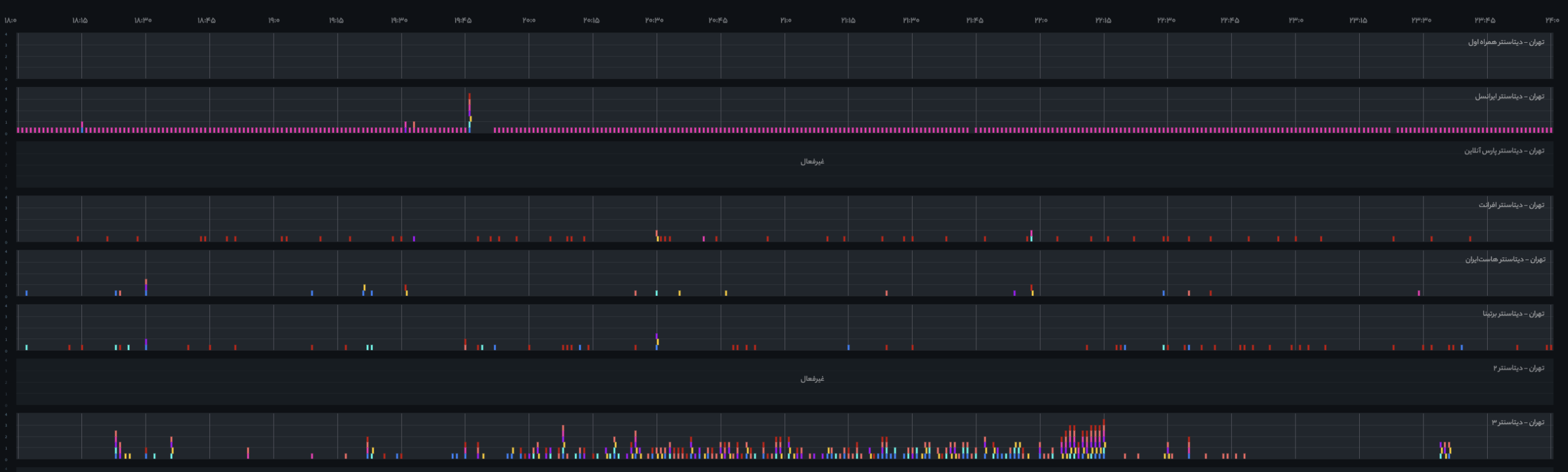
- The vast majority of the month's disruption—256 hours (over 75% of the total disruption time)—was attributable to a single, prolonged outage at the Tehran–Irancell datacenter. This incident began at 8:00 AM on October 22 and persisted until November 1. ArvanCloud data characterized this as a Partial Access Disruption that was observed continuously on international routes (including the Bing route), marking it as the single most significant and longest-lasting disruption of October
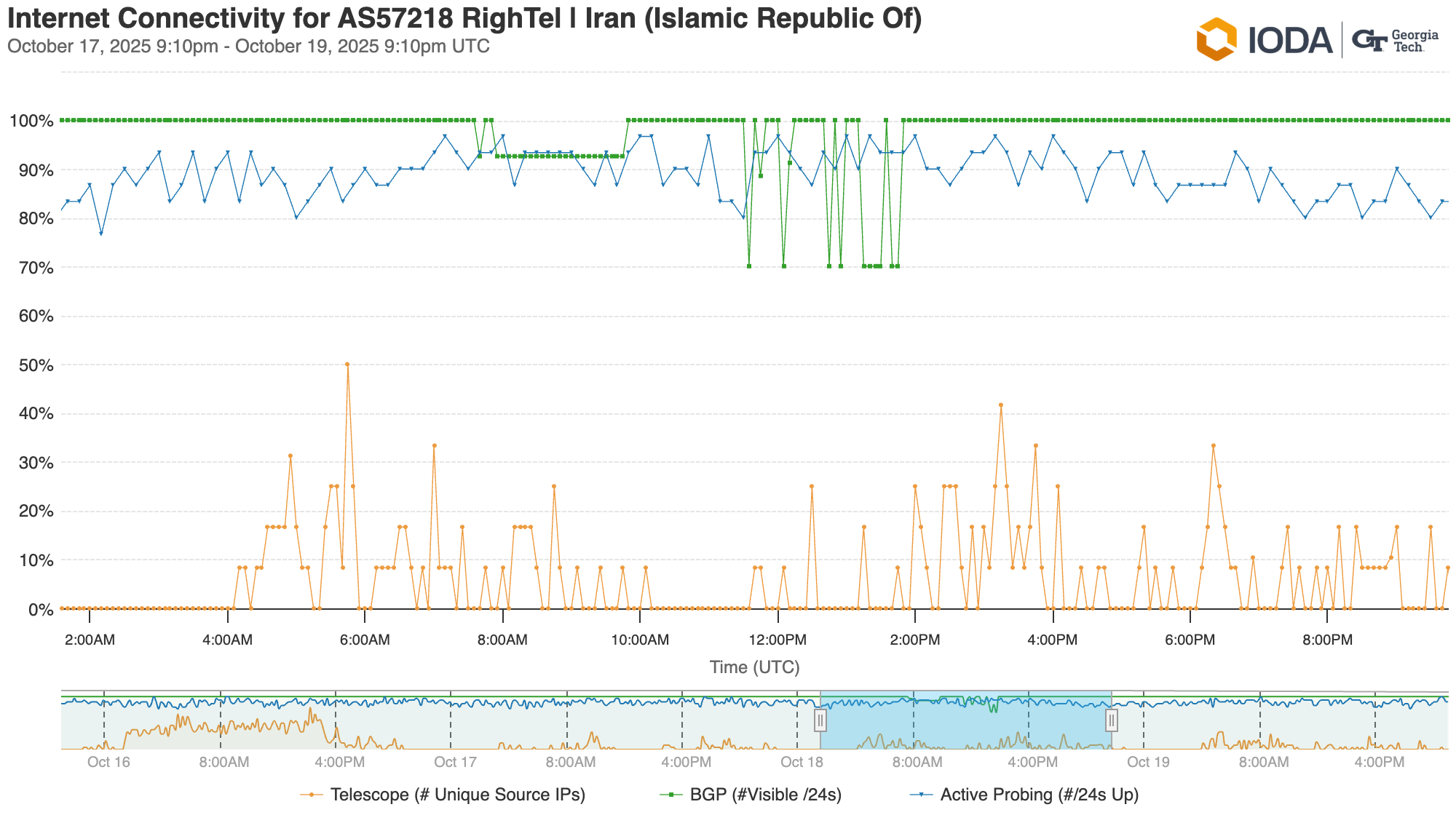
In addition to the datacenter issue, the Rightel operator (AS57218) experienced a notable disruption on October 17, lasting approximately eight hours (10:00 AM to 6:00 PM). Data from IODA and Cloudflare Radar confirm a noticeable drop in BGP Reachability for the Rightel network (AS57218). This outage affected several provinces, including Tehran, Gilan, Qom, Isfahan, and East Azerbaijan, causing intermittent degradation of connection quality.
5.2 Analysis of Disruption Patterns
- Weekly Concentration: The largest share of disruptions (52.1%) was recorded during the period of September 30 to October 6. Major fluctuations were concentrated in the first half of the month, shifting towards continuous datacenter outages in the final weeks.
- Geographic Scope: Most disruptions remained localized, with 95% classified as local (affecting a single city or region). Only 4% simultaneously affected multiple provinces.
- Timing and Scale: In October, the major share of disruptions involved datacenters, and more than half were recorded during off-peak hours (mostly between midnight and morning). In terms of user impact, 93% of the disruptions were classified as "small-scale" (affecting fewer than 500,000 users).