

In September, based on identified disruptions alone, Iran's internet experienced the equivalent of 25 full days of outages in a single month. Despite official claims of "improving internet quality," even officials within the Ministry of Communications have admitted that 80% of users rely on VPNs and 70% of the country's traffic flows through circumvention tools. At the same time, despite promises of a "digital transformation and support for the innovation economy," policy-making in September moved toward greater centralization, control, and restriction across all digital sectors
Key Findings:
- Increased, Shorter Disruptions: There were 158 identified internet disruptions in September, more than double the 60 cases recorded in August. These disruptions, though individually shorter, lasted a total of 617 hours and 15 minutes, equivalent to 25 full days of outages in one month.
- Widespread Impact: Over 70% of the disruptions were of a medium scale, each time affecting the internet access of 500,000 to one million users.
- VPN Usage Soars: While the government talks about "improving internet quality and traffic growth," official data from the Ministry of Communications reveals that over 80% of users rely on VPNs for open internet access, and 70% of the country's traffic passes through filtering circumvention tools. This statistic effectively exposes the ineffectiveness of filtering policies.
- Cryptocurrency Regulations Tighten: New, heavy-handed regulations (e.g., steep capital requirements and stablecoin limits) are designed to eliminate small exchanges and channel the crypto market into a centralized, banking-backed system, prioritizing state control over financial innovation.
- Expanded Digital Surveillance: Policies like reviewing social media in job screenings and creating a "specialized ICT customs" to track and control all imported digital hardware reveal a significant expansion of state surveillance over private life and critical infrastructure.
Internet Access and Infrastructure
1.Internet Disruptions
In September, Iranians experienced a significant number of internet disruptions. According to various network monitoring tools, including the IODA (Internet Outage Detection and Analysis) website, ArvanCloud Radar, and Cloudflare data, a total of 158 outages were identified. These disruptions lasted a combined 617 hours and 15 minutes, which is the equivalent of approximately 25 full days in a single month.
Crucially, while the number of disruptions more than doubled, the total cumulative outage time actually decreased (617 hours in September vs. 680 hours in August). This indicates a shift in tactics from long, sustained blackouts toward a pattern of more frequent, shorter disruptions (micro-outages) across the network.
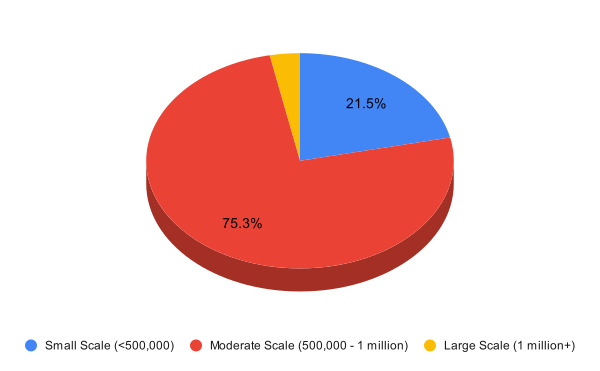
In terms of affected users, the majority of last month's outages were on a medium scale. More than 70% of these disruptions, based on factors like the operator, time, and location, affected the user experience of approximately 500,000 to one million people at a time. This means internet access for half to one million users was affected for 7 out of every 10 disruptions. Data from September indicates that over 90% of the internet disruptions were caused by issues within data centers, suggesting that power outages likely remain a major factor contributing to instability in these facilities.
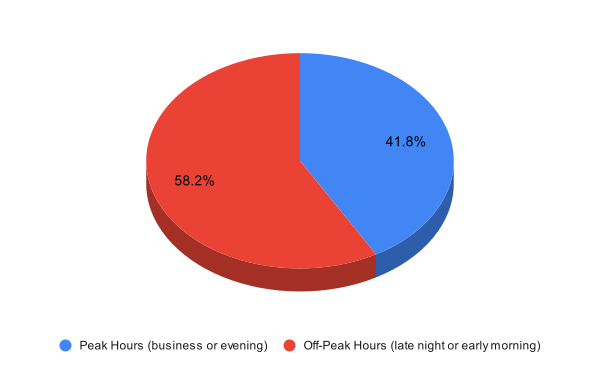
Regarding the timing of these disruptions, about 60% occurred during off-peak hours (e.g., from midnight to 6 a.m.). This is a shift from August, when a larger share of outages took place during peak usage hours.
Geographically, more than 90% of the September disruptions were confined to a single province. Only about 7% affected multiple provinces simultaneously, a pattern consistent with what was observed in August, where most outages were localized to one city or region.
2.State Narrative vs. User Reality
Even in September, official government narratives continued to paint a positive picture of Iran's internet quality. They announced "traffic growth," highlighted "maritime fiber diplomacy" in the region, and launched quality monitoring systems.
However, the reality for users tells a different story: poor quality and ongoing filtering. Even Ministry of Communications officials have admitted that 80% of users are forced to use VPNs, with 70% of the country's internet traffic passing through these circumvention tools. This reality is a direct consequence of the government's filtering policies.
The judiciary once again reiterated its demand for foreign platforms to have a "legal representative in Iran." However, an annual report from Cafe Bazaar (Iran’s version of Google Play) revealed millions of searches for censorship circumvention tools and foreign platforms like WhatsApp and Instagram, highlighting the stark divide between official policies and the public's desire for open internet access.
3.Attack on VPNs and Digital Business
In a move framed as a response to public demand regarding "profiteers of the filtered space," the parliament has officially launched an investigation into VPN sellers. There is concern that this investigation will ultimately lead to increased financial and legal surveillance of ordinary internet users, especially if a clear distinction isn't made between the commercial sale and personal use of these tools.
Furthermore, the sudden blocking of the health platform "Dr. Dr." (an Iranian digital health platform) once again highlighted the instability of the legal environment and the threat to public trust in digital businesses. This abrupt action, carried out without any prior notice, drew protests from the Tehran E-Commerce Association. The "Dr. Dr." website went offline on the morning of September 20th and was back online on September 22nd.
The judiciary once again reiterated its demand for foreign platforms to have a "legal representative in Iran" and to immediately remove "criminal" content. This is a recurring tactic to push users toward domestic platforms.
Policies
1.Cryptocurrency Policies Under Scrutiny
In September, Iran's cryptocurrency policies entered a new phase, focusing more than ever on restriction and surveillance. This trend is rooted in the "Cryptocurrency Charter" approved last year and is being implemented through regulations from the Central Bank (CBI) and the Securities and Exchange Organization (SEO).
Examples of these policies include:
- The division of crypto-related responsibilities between the Central Bank and the Securities and Exchange Organization.
- The approval of strict advertising regulations.
- New requirements for crypto exchanges.
- Setting limits on stablecoin holdings.
The domestic push for centralization directly contradicts the rhetoric that cryptocurrencies can serve as a national tool for sanction resilience and bypassing the dollar. This conflict highlights the government's prioritization of internal control over economic liberalization.
These domestic changes are happening at the same time as escalating external pressures, such as the seizure of Iranian crypto wallets and new financial sanctions. The combination of these two layers of pressure has made free and secure access to digital assets increasingly difficult and risky for Iranian users. From this perspective, September can be seen as the month when Iran's cryptocurrency path was increasingly steered toward centralization, monopoly, and the dispossession of individual ownership.
1.1.Strict Regulations for Crypto-Money Brokers
The Central Bank published the draft of its "Crypto-Money Broker Regulations," setting an official framework for crypto exchanges that completely bans leveraged trading. A key element is the dramatically steep minimum capital requirements. The minimum capital for Type 1 brokers was reduced to 40 billion tomans (approx. $9.5 million), and for Type 2, it was set at 400 billion tomans (approx. $95 million). In October, a final version of this regulation was approved.
Managers of domestic exchanges have warned that these requirements will practically eliminate 95% of small and startup exchanges, paving the way for players with banking support. This structural change transforms the cryptocurrency market from an innovative and open space into a centralized, pseudo-banking network. Ultimately, it will likely be responsible for the migration of capital and users to foreign or underground markets.
1.2. Limits on Stablecoin Purchases and Holdings
The Central Bank set new limits on the purchase and holding of stablecoins like Tether. The annual purchase limit was capped at $5,000 per user, while the holding limit was capped at $10,000. These policies, alongside requirements for asset legitimacy documentation for larger transactions, are seen as a new form of intervention in the ownership of digital assets that will likely drive users toward informal and foreign markets.
1.3. External Pressures Complement Domestic Control
Domestic changes are occurring simultaneously with escalating external pressures, such as the seizure of Iranian crypto wallets by the U.S. Treasury Department. This trend demonstrates that international sanctions and security policies are effectively complementing domestic restrictive policies, making secure access to digital assets increasingly difficult for all Iranian users.
These developments is an increase in pressure and systemic risk for Iranian cryptocurrency users. Centralized stablecoins like Tether, which can be frozen or blacklisted by their issuers, have become more perilous than ever for Iranian users, including ordinary individuals who have committed no wrongdoing. This trend demonstrates that international sanctions and security policies are effectively complementing domestic restrictive policies, making secure access to digital assets increasingly difficult for Iranian users.
1.4. Policy Contradiction: Cryptocurrency as a Tool for Sanction Resilience
In October, at the National E-Commerce Day event, some government officials and private sector representatives proposed cryptocurrencies as an alternative to the dollar and a tool to bypass sanctions. The head of the country's Computer Trade Guild explicitly suggested using cryptocurrency instead of the dollar to counter pressures from the activation of the snapback mechanism. While this perspective is understandable from a standpoint of facilitating trade and economic resilience, it directly contradicts the domestic restrictive policies on crypto assets, including the Central Bank's recent limitations and the ban on public advertising. At the same time, some experts at the meeting emphasized that without serious investment in infrastructure and a shift away from a security-first view of the digital economy, tools like cryptocurrency cannot play an effective role in economic resilience. With the final approval of the crypto-money broker directive, the Central Bank has solidified its position as the main regulator of the crypto market. However, this move, contrary to the global trend toward open and innovative regulation, has pushed the Iranian market toward monopoly, institutional centralization, and heavy financial supervision. In this framework, cryptocurrency is no longer a tool for economic freedom; instead, it is becoming a part of the official banking network.
2. Return of Sanctions and ICT Consequences
With the activation of the multilateral UN snapback sanctions in September, restrictions on Iran’s access to the global supply chain for ICT hardware and software will intensify significantly. While targeted at nuclear and military activities, these sanctions compel international banks and suppliers to fully exit the market to avoid liability. Digital economy experts view the snapback as a major setback that formalizes and intensifies existing economic pressures, making the future of domestic ICT innovation unsustainable. This de-risking can translate directly into domestic ICT instability:
- Cost & Availability: The cost of importing essential IT components, microchips, and networking equipment will rise dramatically, as businesses must now rely exclusively on high-risk, expensive gray markets.
- Cybersecurity Risk: The inability to purchase official software licenses or receive sanctioned security updates and patches from international vendors will directly increase the country’s vulnerability to cyber threats.
- Infrastructure Halt: The long-term development and maintenance of domestic ICT infrastructure (data centers, mobile networks, fiber optics) will be threatened, increasing the frequency of the power-related disruptions already highlighted in this report.
Draft Amendment to the Electronic Commerce Law
The draft revision to Iran's Electronic Commerce Law, published in September, poses a significant threat to the domestic digital economy. Despite being an update to the 20-year-old law, the draft retains language that eliminates safe harbor protection and holds platforms strictly liable for all user-generated content (UGC).
For Platforms: This policy would force local platform-based businesses (like app stores, e-commerce sites with comment sections, and social media) to effectively act as state censors. Because the legal threat could involve severe penalties and financial fines that could jeopardize a platform's operating license, operators would be forced to prioritize pre-emptive surveillance and mass filtering over innovation, effectively making it too risky and costly for local platforms to grow their user services.
For Users: This legal mechanism would likely reinforce digital control by eliminating privacy and trust on Iranian-owned sites. Users will face a severe chilling effect on expression, knowing that the platforms they use would be legally required to police and immediately delete sensitive or critical content, which is a significant departure from international digital rights standards.
3. Other Policies: Surveillance and Hardware Tracking
In addition to cryptocurrencies, other policy decisions solidify the overall trend toward greater supervision, control, and centralization.
- Social Media Surveillance in Hiring: The Supreme Selection Board announced that the public social media profiles of individuals, particularly on Instagram, will now be reviewed as part of the hiring process. This decision effectively expands the scope of surveillance over people's private lives.
- Official Corridor for ICT Equipment Entry: The creation of a "specialized ICT customs" aims to enable the tracking of all electronic equipment entering the country. This policy has serious consequences for digital rights, as it enables the tracking of devices, operating systems, and ultimately, users' free access and personal data security.
Conclusion and Outlook
In September, Iran's digital policy agenda clearly prioritized internal political control and surveillance over genuine economic resilience or digital growth. The combined actions—from highly frequent, localized internet disruptions, the legal attack on digital circumvention, the centralization of the cryptocurrency market, and the establishment of specialized customs to track all imported ICT hardware—demonstrate a consistent, top-down strategy. This strategy aims to contain the digital sphere and advance its project of a nationalized, segregated internet, even at the cost of stifling the very innovation and economic tools (like cryptocurrency) that officials claim could bypass international sanctions. This deliberate campaign of digital enclosure is the signature of a developing Digital Authoritarianism, where the state views open internet access and decentralized finance as threats to be neutralized, rather than assets to be leveraged.